

A prospecting letter gives you a physical way to introduce a relevant idea. Its value depends on the audience, offer and cost. The templates below help you write the note; they do not imply a particular reply rate.
I have seen sales teams at Scribble run prospecting letter campaigns alongside their email sequences and watch reply rates double. Not because the letters are clever. Because they are physical. Because they land on a desk. Because they require a different kind of attention than a notification in an inbox.
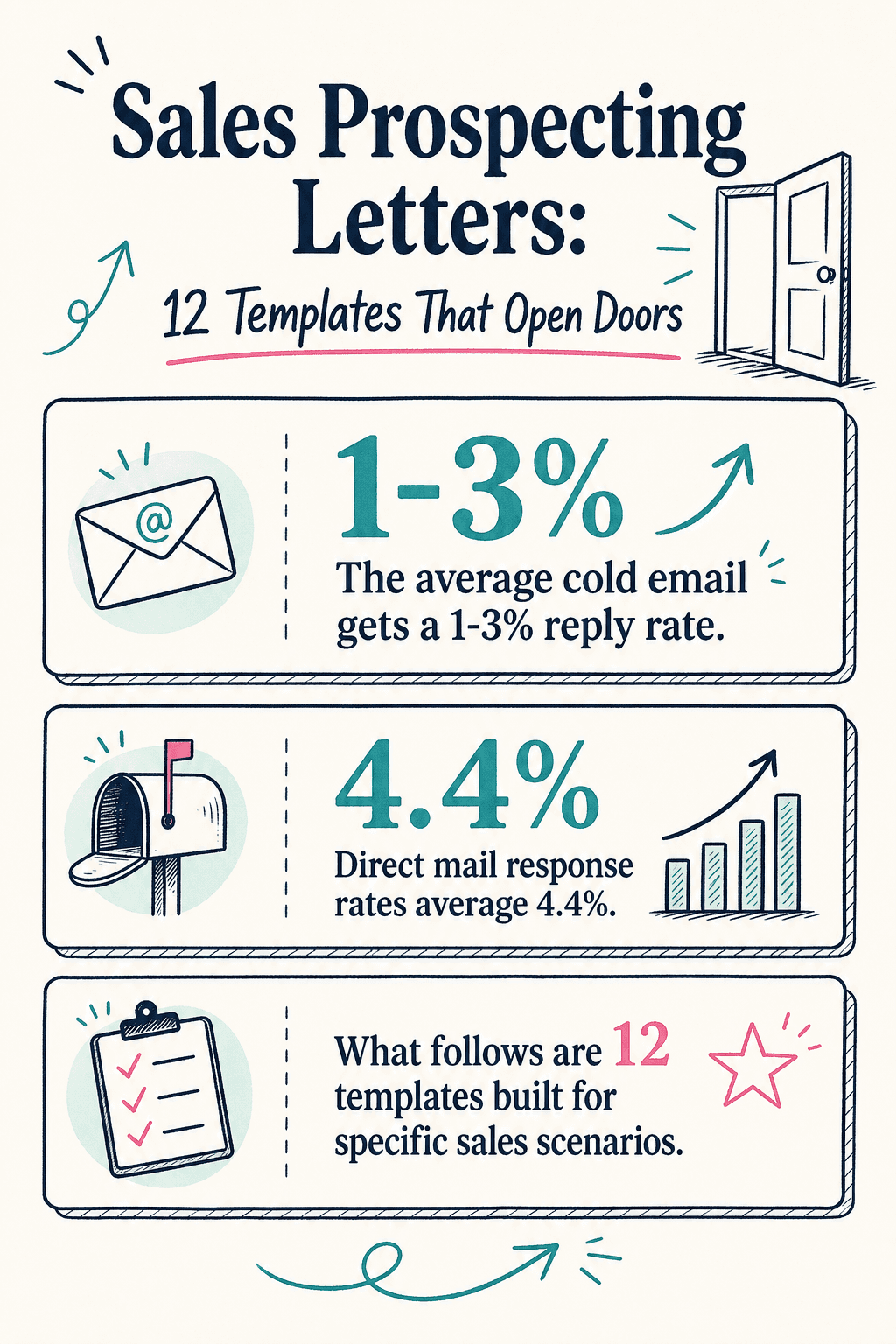
What follows are 12 templates built for specific sales scenarios. Use them as starting points. The best version of any letter is one you have adapted to the actual person you are sending to. That is what separates a prospecting letter from a piece of direct mail junk.
What Makes a Sales Prospecting Letter Actually Work
Most prospecting letters fail for the same reason most cold emails fail: they are about the sender, not the recipient. They open with 'I'm reaching out because...' and spend three paragraphs explaining why the product is great. The prospect does not care. Not yet.
The letters that get responses do three things: they show the sender knows something specific about the recipient's situation, they connect that situation to an outcome the recipient cares about, and they make the next step feel easy and low-risk. Personalization, relevance, and a clear ask. That is the framework behind every template below. For more on how personalization drives results, see our guide on direct mail personalization.
The 12 Sales Prospecting Letter Templates
Each template is written for a specific scenario. The placeholders use [BRACKETS]. Every template should be adapted: change the specifics, reference something real about the prospect's company or role, and adjust the tone to match your brand.
Template 1: Cold Outreach to an Unknown Prospect
Use this for a prospect you have identified through research but have not contacted before. Start with a short, specific introduction and one request. A word limit is an editing choice, not proof of the letter’s value.
[FIRST NAME],
Most [JOB TITLE]s I talk to are dealing with the same two problems: [PROBLEM 1] and [PROBLEM 2]. Not because they are doing anything wrong, but because [ROOT CAUSE].
At Scribble, we help [INDUSTRY] teams [SPECIFIC OUTCOME]. [CLIENT TYPE], for example, saw [SPECIFIC RESULT] within [TIMEFRAME] of running their first campaign.
I would like to show you how we would approach this for [COMPANY NAME]. Would 20 minutes this week or next work?
[YOUR NAME]
[TITLE]
[PHONE / EMAIL]
The specificity of the problem statements is what earns the read. Vague openers lose people in the first two sentences. Name the problem accurately and you have already demonstrated you understand their world.
Template 2: Cold Outreach After Viewing Their LinkedIn Profile
When a prospect has viewed your LinkedIn profile or engaged with your content, the connection is warm enough to reference directly.
[FIRST NAME],
I noticed you stopped by my LinkedIn profile recently. I will take that as permission to reach out.
I work with [JOB TITLE]s at [COMPANY TYPE] who are trying to [GOAL] without [PAIN POINT]. It is a tighter problem than it sounds.
If that resonates, I would be glad to share how we have approached it for teams like yours. No deck, no demo: just a direct conversation about whether there is a fit.
[YOUR NAME]
[CONTACT DETAILS]
Referencing the profile view is honest and disarming. It acknowledges the prior signal without being presumptuous about it.
Template 3: Follow-Up After No Email Response (30 Days)
A prospect opened your email twice but never replied. This letter arrives at their desk 30 days later.
[FIRST NAME],
I sent you an email about [TOPIC] a few weeks back. You did not reply, which is entirely reasonable: your inbox is probably a nightmare.
I figured a letter was worth trying.
The short version: [COMPANY NAME] helps teams like yours [SPECIFIC OUTCOME]. I think there is a real fit here. If I am wrong, five minutes on a call will confirm it.
I will try once more by email next week. If this is not the right time, no problem: I will take you off my list and come back in six months.
[YOUR NAME]
The honesty about previous contact, the acknowledgment that they may genuinely be uninterested, and the clear exit ramp all reduce resistance. A prospect who was not ready before may respond now simply because the tone is different.
Template 4: Post-Demo Thank You and Next Steps
Send this within 24 hours of a product demo. Handwritten is best here: it signals the relationship matters beyond the sale.
[FIRST NAME],
Thank you for the time today. I came away from the call with a clearer picture of what you are working with, and I think there is a genuine fit.
The three things I want to make sure we address for you: [POINT 1], [POINT 2], and [POINT 3]. I have asked [COLLEAGUE NAME] to put together a proposal that speaks directly to those.
You will have it by [DATE]. In the meantime, I am available if anything else comes up.
[YOUR NAME]
Handwritten post-demo notes are rare enough that they are remembered. They also reinforce that the meeting was a real conversation, not a scripted pitch.
Template 5: Win-Back Letter for a Lapsed Prospect
A prospect went cold at the 60-90 day mark. This letter is designed to re-open the conversation without relitigating the original pitch.
[FIRST NAME],
We spoke a few months back about [TOPIC]. The timing was not right and I did not push it.
I am reaching out because [SPECIFIC REASON: new feature, relevant case study, changed market condition]. I think the conversation we started might look different now.
If you are open to a quick catch-up, I would welcome it. If the timing still is not right, I completely understand.
[YOUR NAME]
Win-back letters work when they acknowledge the previous conversation and give a genuine reason to re-engage, not just 'checking in.' The specific reason signals that the sender has been paying attention.
Template 6: Referral From a Mutual Contact
A shared connection has suggested you reach out. Ask permission to name that person, and describe the introduction accurately.
[FIRST NAME],
[MUTUAL CONTACT] suggested I reach out. They thought what we do at Scribble might be relevant to some of the challenges you have mentioned to them.
Specifically, [MUTUAL CONTACT] mentioned [PROBLEM/GOAL]. That is exactly the kind of situation we work on.
I will not take more than 20 minutes of your time. Would [DATE OPTIONS] work?
[YOUR NAME]
Referral letters have the highest open and response rates of any prospecting format. The name in the first line converts attention into readership almost automatically.

Template 7: Post-Conference or Post-Event Letter
You met briefly at an event but did not have time for a real conversation. This letter arrives in the week after.
[FIRST NAME],
It was good to meet you at [EVENT NAME] last week. I did not get a chance to tell you much about what we do at Scribble: the conversation moved on before I had the chance.
The short version: we help [PROSPECT'S INDUSTRY] teams [OUTCOME]. Given what you mentioned about [SPECIFIC THING THEY SAID], I think there might be something worth a 20-minute follow-up.
I will follow up by email this week. Looking forward to continuing the conversation.
[YOUR NAME]
Referencing something specific they said at the event is what separates this from a generic conference follow-up. If you did not write it down at the event, you probably should not be sending this letter.
Template 8: C-Suite Executive Outreach
Senior leaders need a different approach. Less detail, more framing. They delegate; your job is to make them want to delegate it to the right person.
[FIRST NAME],
I will keep this brief.
[COMPANY NAME] does [WHAT YOU DO] for [COMPANY TYPE]. We can share [A RELEVANT EXAMPLE YOU CAN SUBSTANTIATE] if that would help you assess whether a conversation is worthwhile.
I would like to explore whether there is a fit with [PROSPECT COMPANY]. I am not asking for your time directly: just a referral to whoever on your team owns [RELEVANT AREA].
[YOUR NAME]
[TITLE, COMPANY]
[CONTACT]
C-suite letters that ask for a meeting rarely work. Letters that ask for a 30-second internal referral have a much higher hit rate. Executives are comfortable delegating: make it easy for them to do that.
Template 9: Voicemail Follow-Up Card
Use this when a card follows a voicemail. Allow for preparation and the estimated postal window; do not promise that it will arrive two or three days later.
[FIRST NAME],
I left you a voicemail earlier this week about [TOPIC]. If you had a chance to listen and it was not the right fit, no worries at all.
If you are curious about [SPECIFIC OUTCOME], I think 15 minutes would be worth it. You can reach me directly at [PHONE] or [EMAIL].
[YOUR NAME]
Multi-channel follow-up that references the previous touchpoint performs significantly better than repeating the same channel. The letter also gives a prospect who listened to the voicemail but did not act on it a low-friction way to respond.
Template 10: Industry-Specific Outreach
Tailoring a letter to a specific vertical dramatically improves response rates. This example is written for financial services.
[FIRST NAME],
Client retention in financial services has a different weight than in most industries. A single lapsed relationship can represent years of revenue.
I work with wealth management firms and RIAs who use handwritten outreach to stay connected with high-value clients between formal review periods. The results we see consistently: improved retention, more referrals, and stronger client satisfaction scores.
I would like to show you what this looks like in practice. Would a 20-minute call next week work?
[YOUR NAME]
Industry-specific letters signal that the sender has done their homework. The opening line names a problem that is specific to the vertical, not just a generic pain point.
Template 11: Account Expansion to a New Department
You are already working with one team at a company. This letter opens a conversation with a different department.
[FIRST NAME],
We have been working with [EXISTING CONTACT] and the [EXISTING TEAM] at [COMPANY NAME] for [TIMEFRAME]. I will not go into all the detail here, but the results have been strong: [BRIEF OUTCOME].
[EXISTING CONTACT] thought it might be worth introducing you to what we are doing, given that [REASON YOUR WORK IS RELEVANT TO THEIR DEPARTMENT].
I would be glad to walk you through it directly. A 20-minute introduction call would cover everything you would need to make a judgment call on whether it is worth exploring.
[YOUR NAME]
The warm reference from the existing contact does most of the work. This letter would be far less effective without it.
Template 12: Handwritten Card for High-Value Prospects
For your top 20-30 highest-value prospects, a fully handwritten card: not just a template: justifies the extra effort. This is a framework, not a template. Every word should be specific to the recipient.
[FIRST NAME],
[ONE SENTENCE that shows you know something specific about their company, role, or a recent development: not generic flattery.]
[ONE SENTENCE that connects what you do to their situation without sounding like a pitch.]
[ONE SENTENCE: the ask. Make it specific and low-commitment: a 15-minute call, a single question they could reply to, a specific date.]
[YOUR NAME]
The handwritten format matters here more than the words. A card written in real ink, addressed by hand, signals a level of attention that no printed letter can match regardless of how it is personalized. This is what handwritten notes for sales can accomplish at the highest end of the spectrum.
How to Personalize These Templates
Every template above has placeholders. The ones that are easy to fill in: name, company, job title: are table stakes. The placeholders that require research are where the results come from.
Company-specific pain point: reference a recent earnings call, a job posting for a role that signals a challenge, or a public statement from their leadership
Role-specific context: CFOs care about different things than CMOs. Tailor the problem statement to the decision-maker's actual priorities
Timing signal: a recent funding round, a merger, a new product launch, or a leadership change all create natural reasons to reach out
Shared connection: if you have one, use it in the first sentence. It changes the read-rate immediately
The more specific the personalization, the shorter the letter can be. A letter with a genuinely precise opening line can be 80 words and outperform a generic 300-word letter every time. For more on this, see our guide on direct mail personalization.
Sending at Scale Without Losing Authenticity
The challenge with prospecting letters is volume. Your top 10 prospects are easy to write for specifically. Your top 200 is harder. A few approaches that work:
Segment by vertical first: write one strong industry-specific template per segment rather than one generic template for all. Ten well-written vertical templates outperform one generic one at any volume
Use triggers for timing: letters sent within 48 hours of a signal, such as a job change, a funding round, or a conference attendance, perform significantly better than batch-and-blast campaigns
Reserve handwritten for the top tier: not every prospect in a 500-person campaign justifies the same investment. Identify the top 20-30 by deal size or strategic value and go fully handwritten for those
Scribble's platform is built for exactly this kind of tiered outreach. You can run a personalized printed letter campaign at scale and layer in handwritten cards for your highest-priority accounts, all from the same dashboard. See our roundup of direct mail marketing tips for more on building campaigns that convert.
Frequently Asked Questions
What is a sales prospecting letter?
A sales prospecting letter is a physical message sent to a potential customer as part of an outreach campaign. It can support a conversation when the reason for contact is relevant. Measure qualified replies and cost instead of assuming a channel-wide response rate.
For a broader view of direct mail returns, our guide to direct mail ROI covers the benchmarks and measurement frameworks in detail.
How long should a sales prospecting letter be?
For cold outreach, a short letter with one clear request is a useful starting point. Follow-ups may need more context. Fit the wording to the available space and test it; there is no proven universal word count that makes a letter perform better.
What is the difference between a printed letter and a handwritten card?
A printed letter arrives in a windowed envelope and is processed mentally as business mail. A handwritten card arrives in a hand-addressed envelope and is treated differently: it gets opened first, read carefully, and kept longer. For high-value prospects, the format difference alone can double response rates.
How do I measure whether my prospecting letters are working?
Use a campaign-specific link or response code if it helps your process, and record replies and booked meetings. Ask how respondents heard about you. These are attribution signals, not proof that every later sale was caused by the letter.
Can I use these templates for email too?
Some can be adapted, but the context is different. Email templates need shorter subject lines, more aggressive openings, and different calls to action. The formats that work best as letters, particularly the handwritten card framework and the post-demo note, do not translate well to email. Use them where the medium earns them.
Ready to Send?
Prospecting letters work because they are doing something different from everything else in a prospect's inbox. They take time, they take effort, and they show up in a way that digital outreach stopped being able to replicate years ago.
The 12 templates above are starting points. The ones that will actually open doors for you are the ones you have adapted to a real person, a real company, and a real situation they are navigating right now. That is what a prospecting letter is, at its best.
Ready to send your first campaign? Start a campaign today with Scribble.