Handwritten Notes for Sales: What the Data Says and How to Use Them
A sales note can follow a meeting, acknowledge a decision or reopen a relevant conversation. Its value depends on the relationship and the cost of making contact, not a universal comparison with email or LinkedIn. Further reading: Postalytics compilation.
The research below provides context for the idea. It does not predict a B2B campaign result.
A 2022 online-retail field experiment found benefits from handwritten notes in a particular customer setting. Treat that as a reason to investigate a suitable use, not a promised doubling of sales. Further reading: Published research.
This guide covers the research’s limits, possible points in a sales cycle, example wording and a budget calculation. It does not report results from a verified dataset of Scribble campaigns.
The Research Behind Handwritten Notes in Sales
Start with what the published research actually examined and what it leaves unanswered.
Kim, Choi and Kim’s 2022 Journal of Interactive Marketing abstract reports a randomized online-retail experiment. Handwritten notes increased spending among loyal customers, while an added marketing incentive weakened the benefit. The reported effects did not extend to nonloyal customers. Further reading: Journal of Interactive Marketing.
Read those findings with their limits:
The result concerns the studied retailer and customer groups, not an average for B2B sales teams.
The public abstract does not establish a general rule that printed notes have no value.
It does not establish that robot-written and human-written cards perform identically.
Product quality still needs a physical sample and a test with your own audience.
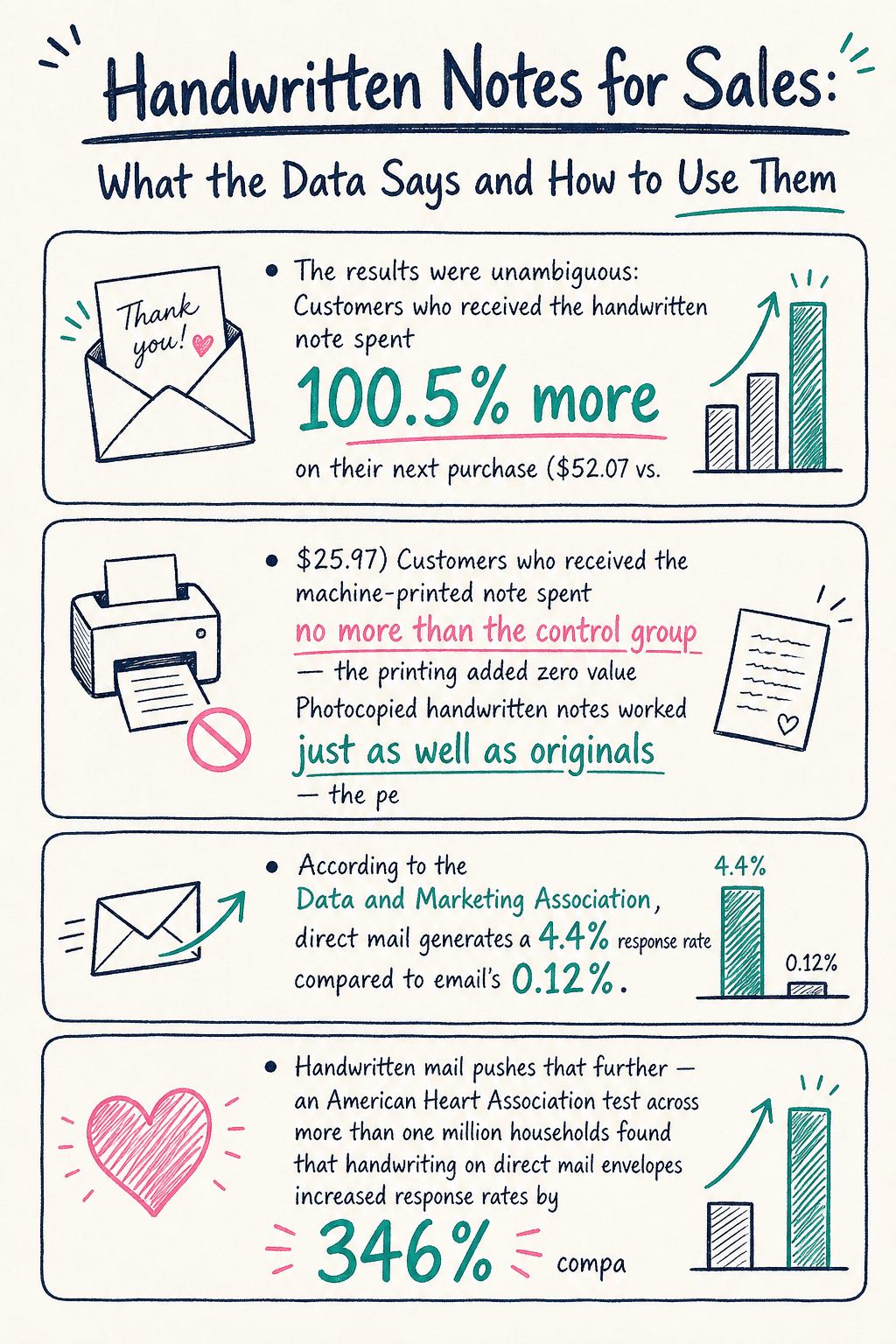
Do not combine response figures from unrelated mail and email reports into a multiplier. Their audiences, outcome definitions and dates may differ; an envelope-treatment test also cannot establish the result of a complete Scribble card campaign. Further reading: Data and Marketing Association.
Why does this work? Three reasons.
A personal reference. A note can mention a specific point from the conversation instead of repeating a general sales pitch.
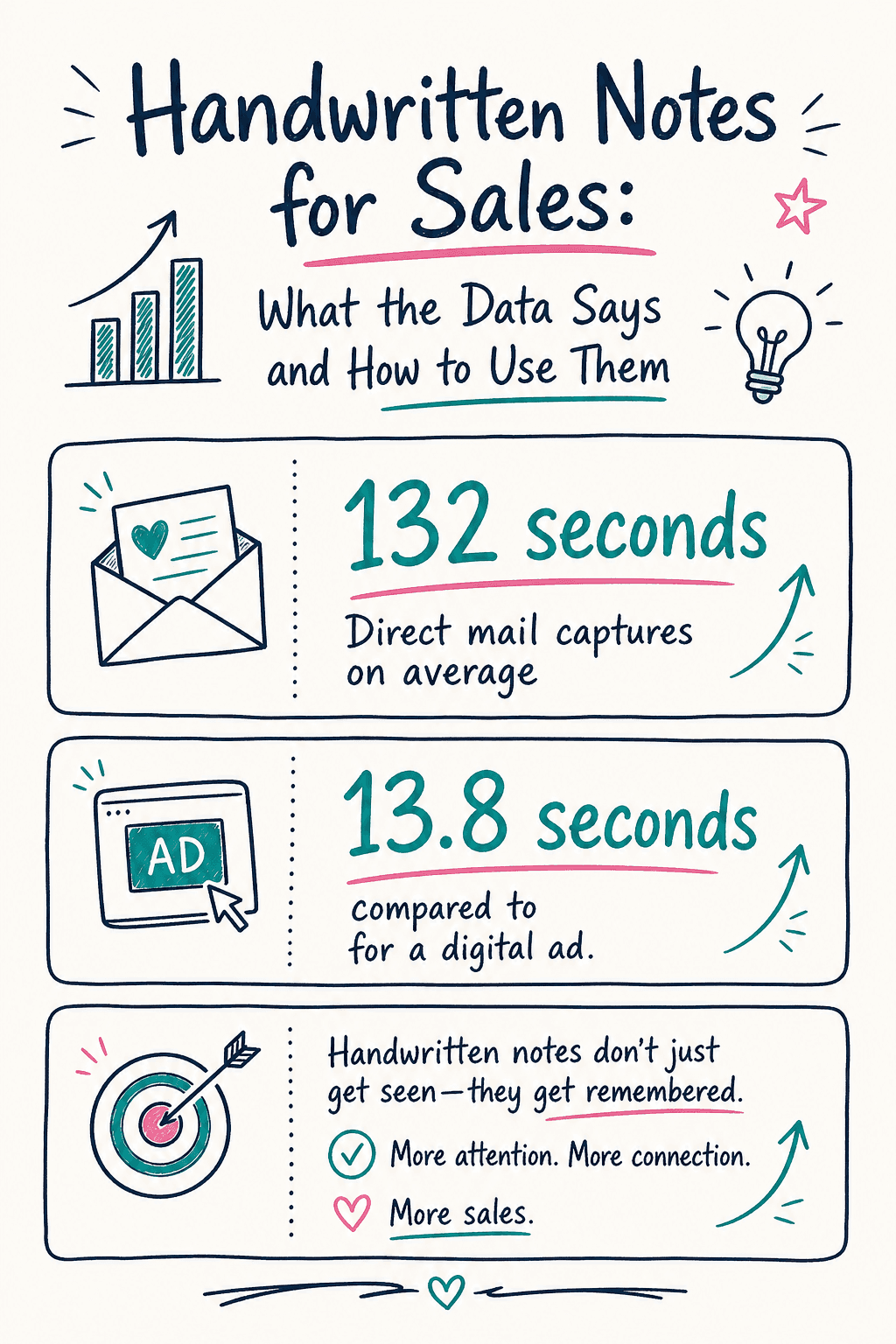
A physical format. Paper gives the recipient something they can keep, but it does not establish a guaranteed amount of attention or a later purchase. Further reading: Postalytics compilation.
A clear acknowledgment. Thank someone for their time without implying that they owe you a reply or a purchase.
When to Send a Handwritten Note in Your Sales Cycle
Choose a moment when you have something relevant to say. The following are possible triggers to test, not proven shortcuts to a faster deal.
Within 24 hours of a first meeting or demo
After a first meeting, a short note can refer to a problem or priority the prospect raised. Prepare it promptly and allow for transit. Use email for any information they need before the card’s estimated arrival.
Record the trigger and outcome in your CRM so you can compare this follow-up with your usual process.
After sending a proposal
The period between "proposal sent" and "decision made" is where deals go silent. The prospect is comparing options, running numbers, getting pulled into other priorities. Your email follow-ups are getting buried.
A handwritten note during this window does something no digital touch can: it creates a physical reminder of your conversation sitting on their desk. It's hard to ignore something you can hold in your hands.
When a deal goes cold
Every pipeline has them — the leads that went dark after two or three emails. Before you write them off, try a handwritten note. It's the ultimate pattern interrupt. The format alone — a real envelope with real handwriting — signals that this isn't another automated sequence. That signal is often enough to restart a conversation that email couldn't.
If you want to go deeper on the letter format itself, we have a full guide to sales prospecting letters with 12 templates for every stage of the sales cycle.
After closing the deal
After closing, a thank-you card can name what the client entrusted to you and explain the next step. Continue with the promised onboarding; the note cannot substitute for delivering the work.
At milestones
Work anniversaries, promotions, company funding rounds — these are moments your competitors aren't recognizing. A handwritten card acknowledging a prospect's or client's achievement has no visible sales purpose, which is exactly what makes it effective. You're building a relationship, not running a sequence.
What to Write on a Handwritten Sales Note
This is where most people stall. They overthink it, write too much, or default to something generic that could have been addressed to anyone. Here's the rule that governs everything:
Three to five sentences is a useful starting point for a short card.
Use enough space to make the message specific and clear. Preview the full wording; a sentence limit is a writing choice, not an established conversion rule.
The principles that matter
Reference something specific. Mention a detail from your conversation, their company, or something you genuinely noticed. "I enjoyed our conversation" is forgettable. "Your point about the challenge of scaling outreach beyond the northeast market stuck with me" is memorable. Specificity is what makes a note feel personal.
For a thank-you note, consider keeping the acknowledgment separate from a sales offer. For promotional mail, state the offer honestly and test its effect on contribution after discount costs.
Sign your real name. Not "The Team at [Company]." Not a printed signature block. Your actual name, written in pen. This is a person-to-person communication, not a brand touchpoint.
Template 1 — After a demo or first meeting
"[Name] — Really appreciated you walking me through how your team handles [specific process]. The challenge you mentioned with [specific detail] is something I've been thinking about since our call. Looking forward to continuing the conversation. — [Your name]"
Template 2 — Proposal follow-up
"[Name] — Wanted to send a quick note while you're evaluating options. Whatever you decide, I hope the proposal gave you a clear picture of what's possible. Happy to answer anything that comes up. — [Your name]"
Template 3 — Re-engaging a cold lead
"[Name] — It's been a while since we connected, and I didn't want to add another email to the pile. If [the challenge they originally mentioned] is still on your radar, I'd genuinely love to pick the conversation back up. — [Your name]"
Template 4 — Post-close thank you
"[Name] — Wanted to say thanks properly. We're excited to work with your team, and I'm personally invested in making sure this delivers for you. Don't hesitate to reach out directly if anything comes up. — [Your name]"
Template 5 — Milestone or congratulations
"[Name] — Saw the news about [specific milestone — funding round, promotion, award]. Well deserved. Exciting things ahead for you and the team. — [Your name]"
Notice what these templates share: they're short, specific, and they don't ask for anything. That's deliberate. The note does the selling by not selling.
The ROI Math on Handwritten Notes for Sales
Start with the cash needed for the mailing and the contribution required to cover it.
The following is an illustrative budget, not a customer case study.
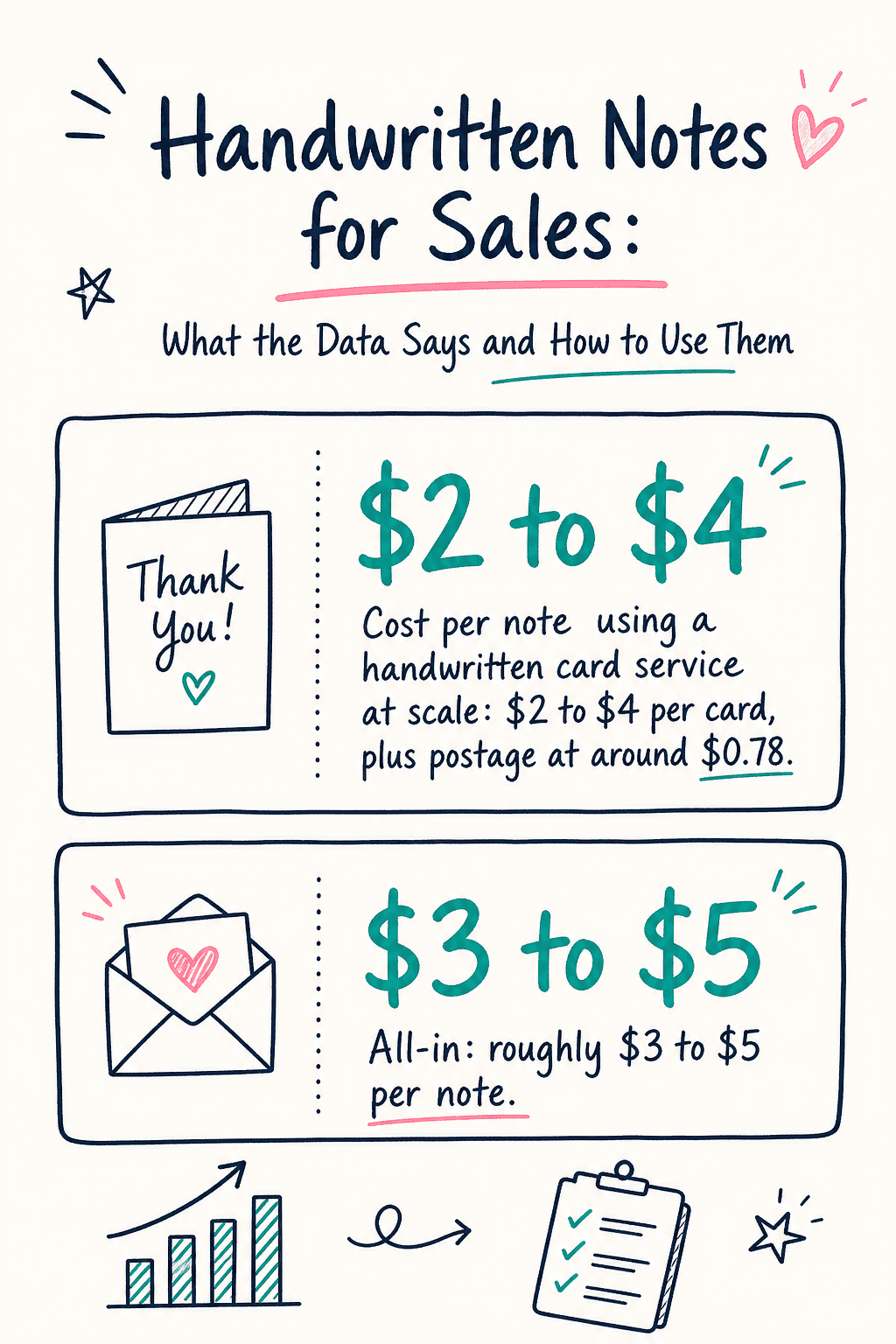
At the single-card rate, a standard Scribble card costs $6.99 with US postage included. Larger credit purchases reduce the per-card rate.
Illustrative card cost: 50 × $6.99 = $349.50, before staff time and any outside tools.
Now look at the return.
Assume one additional sale is caused by the mailing, with $10,000 revenue and a 40% contribution margin. That produces $4,000 contribution. This is an assumption to test, not an expected close-rate improvement.
Assumed incremental contribution: $4,000.
Illustrative card cost: $349.50, with additional staff and tool costs still to include.
Illustrative ROI before those additional costs: ($4,000 - $349.50) / $349.50 ≈ 1,044.5%. If the mailing causes no additional sale, that return disappears.
The sales assumption is deliberately explicit. A retail experiment cannot establish the likelihood that this B2B mailing will cause a sale. Run a comparison and keep uncertainty visible.
Compare your mailing cost with the conversations it produces. Scribble shows card progress and arrival windows, ending when the card is handed to USPS. Use your own CRM to connect replies to later meetings or sales. For the sending process, see sending cards to a list.
A test can help you decide whether another mailing is worth its cost. Do not count every later sale as caused by the card.
How to Scale Handwritten Notes Without Losing Authenticity
The obvious question: "If I'm sending 50 notes a month, I can't write them all myself. And if a machine writes them, doesn't that defeat the purpose?"
Automation can prepare a consistent mailing, but it does not prove that recipients see automated and personally written notes the same way. Compare the product sample and message with the impression you want to make.
Scribble uses pens to write messages on cards. Review a sample to inspect the ink and paper, and check a preview of your actual message before sending. Do not describe an automated mailing as personally written by a staff member.
If you're evaluating a service, here's what to look for:
Real pens, not printed fonts. Many services print a handwriting-style typeface onto paper and call it "handwritten." Recipients notice — maybe not consciously, but the perfect uniformity registers as off. Look for actual pen-on-paper writing with natural pressure variation.
Handwritten envelopes. The envelope is the first thing the recipient sees. If the card inside is handwritten but the envelope is a printed label, you've lost half the effect before they open it.
Real postage stamps. A bulk-rate permit stamp tells the recipient this is mass marketing. A real stamp says "someone went to the post office for me."
Personalization at the individual level. You need variable fields — recipient name, company, specific details — merged from your CRM or contact list. Generic notes sent at scale are just expensive spam.
Tracking. Record replies and outcomes in your CRM. A campaign-specific link can provide another signal if you implement it, but a scan does not prove a sale was incremental.
If you want to see how this works end to end, here's how Scribble works — from card design and mail merge to delivery tracking and follow-up.
Five Mistakes That Kill the Impact of Handwritten Notes
These are practical issues to check before a mailing. Their importance depends on the purpose and audience.
1. Including a promotional offer.
Decide whether this is a thank-you or a promotion. A discount may change how a note is received and also changes the margin calculation. It is not a universal rule that an offer cancels every benefit.
2. Using a printed font that mimics handwriting.
Inspect the actual product. A printed handwriting-style message and a pen-written card are different options, but the cited research does not establish that real ink always improves sales.
3. Sending generic messages.
"Dear Valued Customer, Thank you for your business" is not a handwritten note. It's a form letter in cursive. Every note needs at least one specific reference — a conversation detail, a company milestone, a challenge they shared. If you can't personalize it meaningfully, don't send it.
4. Sending at the wrong moment.
Match timing to the reason for the note and the recipient’s decision window. Prepare it promptly when relevant, but allow for production and transit instead of promising a two-day arrival.
5. Not tracking results.
Handwritten outreach is only as valuable as your ability to measure what it produces. Use individual QR codes, unique landing page URLs, or CRM-tagged follow-up sequences to connect notes to pipeline outcomes. Without measurement, you're spending money on hope — and that's not a strategy.
If you are ready to put this into practice, see our comparison of the best handwritten card services to find the right fit for your sales team's volume and budget.
Frequently Asked Questions
How much do handwritten notes for sales cost?
A standard Scribble card is $6.99, including handwriting, envelope and US postage. The $2.45 rate requires buying 10,000 prepaid credits in one purchase; smaller purchases use the current volume table. At $6.99, 50 cards cost $349.50 before your preparation time.
Do handwritten notes actually increase sales?
They may help in some settings. The cited retail study is limited to its population and intervention, and does not predict B2B sales or Scribble open rates. Compare your own outcomes and costs.
Can I automate handwritten notes without losing authenticity?
You can automate production and still write a specific, accurate message. Review the merged text and physical sample. Avoid implying that a named employee personally wrote every card if the writing was automated. Further reading: Scribble.
When is the best time to send a handwritten note in B2B sales?
A first meeting, proposal, completed project or real milestone can give you a reason to write. Choose the trigger that fits your sales process and evaluate it; there is no universally best send time.
How many handwritten notes should a sales team send per month?
Start with 10 to 15 per rep per month, targeting your highest-value prospects and recently closed deals. As you measure results and refine your approach, scale to 25 to 50 per rep. Consistency matters more than volume — a steady cadence of thoughtful, personalized notes outperforms sporadic bursts every time.
Start with a relevant recipient, a specific message and a test budget. Track what happens and decide whether the program should continue from the measured result.
The one thing I'd encourage you to do today: send one note. Pick a prospect who went cold, a client who just signed, or someone you met last week. Write three sentences that reference something specific. Mail it. Then watch what happens.
If you want to do that at scale without the wrist cramp, start a campaign with Scribble.
Looking to take your outreach even further? Read our guide on cold outreach with handwritten notes for a full breakdown of how to combine physical mail with your email sequences.