Handwritten Cards for Nonprofits: How to Increase Donor Retention
Learn how handwritten cards help nonprofits increase donor retention rates. Data-backed strategies, real case studies, and scalable solutions for nonprofit teams.

Most nonprofits lose more donors than they keep. The AFP Fundraising Effectiveness Project reports that the average donor retention rate sits at just 43 to 45%. For first-time donors, it's even worse: only about 19 to 20% give a second time. That means for every 10 new donors you acquire, 8 of them never come back.
The leading cause isn't dissatisfaction with your mission. It's silence. Research from Bloomerang shows that 70% of donors who stop giving say it's because they felt the organization no longer needed them or didn't communicate enough. They didn't leave. They were forgotten.
In my work at Scribble, I've seen one tactic consistently reverse this trend: handwritten cards for nonprofits. Not automated emails. Not printed form letters. Real, pen-on-paper thank you notes that donors can hold in their hands. This guide covers why they work, the data behind them, and how to implement a scalable handwritten card program at your organization.
The Nonprofit Donor Retention Problem (By the Numbers)
Before we talk about solutions, let's look at the scale of the problem:
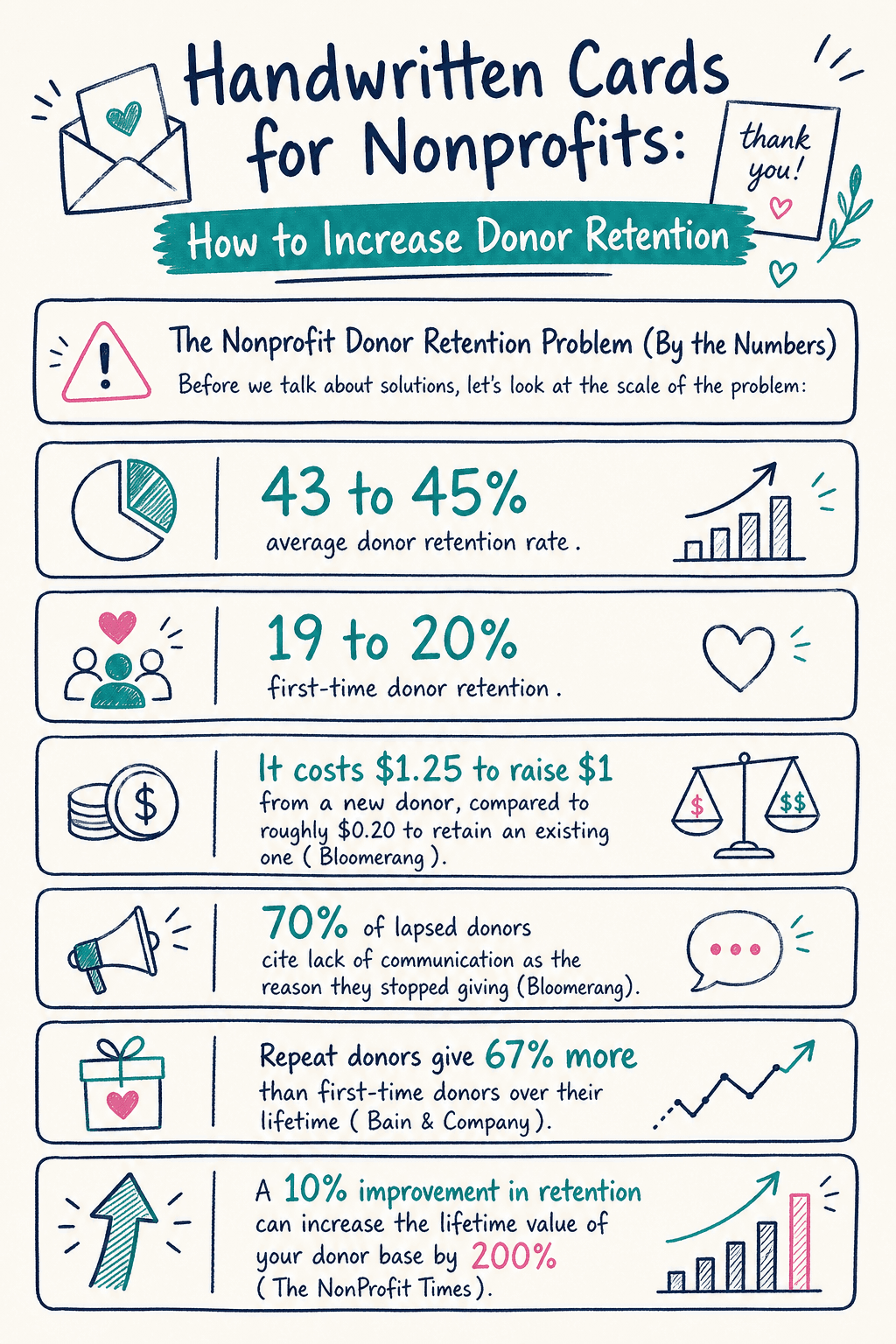
43 to 45% average donor retention rate. More than half your donors vanish each year (AFP Fundraising Effectiveness Project).
19 to 20% first-time donor retention. The vast majority of new donors are one-and-done (AFP).
It costs $1.25 to raise $1 from a new donor, compared to roughly $0.20 to retain an existing one (Bloomerang).
70% of lapsed donors cite lack of communication as the reason they stopped giving (Bloomerang).
Repeat donors give 67% more than first-time donors over their lifetime (Bain & Company).
A 10% improvement in retention can increase the lifetime value of your donor base by 200% (The NonProfit Times).
The math is clear: keeping donors is dramatically more cost-effective than finding new ones. Yet most nonprofits spend the majority of their budget on acquisition.
Why Handwritten Cards Work for Donor Retention
Handwritten mail operates on a completely different level than digital communication. Here's what the data shows:
99% open rate for handwritten mail, compared to 20 to 25% for nonprofit emails (LettrLabs).
5.3% response rate for nonprofit direct mail, vs 0.1% for email (ANA/DMA Response Rate Report).
38% higher repeat donation rate when donors receive handwritten thank you notes (DonorsChoose case study).
132 seconds of attention for physical mail vs 11 seconds for email (see our direct mail statistics roundup).
USPS and Temple University research found physical mail activates deeper emotional and memory responses in the brain than digital messages.
The reason is simple: a handwritten card signals genuine, human effort. In an era where donors receive dozens of automated emails per week, a physical note stands out. It tells the donor they matter enough for someone to pick up a pen.
Real Nonprofits, Real Results
DonorsChoose: 38% Increase in Repeat Donations
DonorsChoose, the education crowdfunding platform, ran a controlled test where teachers sent handwritten thank you notes to donors. Donors who received handwritten notes were 38% more likely to donate again compared to those who received standard automated receipts. The program now runs as a core part of their donor stewardship strategy.
Charity: Water's Handwritten Approach
Charity: Water became one of the fastest-growing nonprofits in part by treating every donor like a VIP. Their team sends personalized, handwritten notes to donors at key giving milestones. Combined with their radical transparency (GPS coordinates of completed wells), this personal touch helped them raise over $700 million from individual donors. The handwritten component creates an emotional connection that transactional receipts simply cannot.
What These Organizations Have in Common
Both organizations treat donor communication as a relationship-building exercise, not a transaction. The handwritten card isn't a replacement for their broader strategy. It's the differentiator that makes donors feel individually valued.
How to Build a Handwritten Card Program for Your Nonprofit
Here's the step-by-step process I recommend for nonprofits looking to implement handwritten cards at scale.
Step 1: Identify Your High-Impact Touchpoints
You don't need to send a card for every interaction. Focus on the moments that drive retention:
First donation thank you: This is the most critical. First-time donors have a 19% retention rate. A handwritten note within 48 hours of their first gift can significantly improve the odds they give again.
Annual giving anniversary: Acknowledge the one-year mark of their first donation. This reinforces the relationship and primes them for another gift.
Major gift acknowledgment: Any donation above your average gift amount deserves a personal note, not just a tax receipt.
End-of-year gratitude: A December card that thanks them for their impact during the year (with a specific example) is far more effective than a year-end appeal disguised as a thank you.
Lapsed donor re-engagement: A handwritten "we miss you" note to donors who haven't given in 12+ months. No ask, just gratitude for their past support.
Step 2: Write Messages That Feel Personal
The message matters as much as the medium. Generic messages undermine the entire effort.
Good example: "Maria, your $150 gift helped provide clean water to 3 families in rural Honduras this spring. Thank you for making that possible. We genuinely could not do this work without supporters like you."
Bad example: "Dear Donor, thank you for your generous contribution. Your support is greatly appreciated."
The difference is specificity. Reference their name, their gift amount (or impact), and a concrete outcome. If you're sending handwritten thank you cards to donors, every card should feel like it was written by someone who knows what their donation accomplished.
Step 3: Choose a Scalable Solution
The biggest challenge for nonprofits isn't knowing that handwritten cards work. It's finding time to send them. Staff and volunteer hours are precious, and hand-writing 500 cards per month isn't realistic.
This is where a handwritten card service makes the difference. At Scribble, we work with nonprofits to send authentic handwritten cards at scale:
Real pen-on-paper writing in 7 distinct handwriting styles
Volume pricing from $3.50 per card down to $1.40 at scale, making it viable for nonprofit budgets
QR code tracking (+$0.45/card) to measure donor engagement after receiving the card
CRM integration for organizations sending 1,000+ cards, triggering cards automatically from your donor management system
No subscription required. Pay per campaign, which fits grant-funded budgets
Personalized messages for each recipient, not one-size-fits-all templates
This gives your organization the warmth and personal impact of handwritten communication without burning hundreds of volunteer hours.
Step 4: Integrate With Your Donor Management System
The most effective handwritten card programs run automatically. Set up triggers in your CRM (Bloomerang, DonorPerfect, Salesforce Nonprofit Cloud, etc.) to send cards at key moments:
New donor: Auto-trigger a welcome/thank you card within 48 hours of first gift
Recurring donor milestone: Send a card after 6 months or 12 months of consecutive giving
Lapsed donor: Trigger a re-engagement card when a donor hasn't given in 90+ days
Major gift: Auto-send a premium thank you for gifts above a threshold you define
Birthday/anniversary: If you capture donor birthdates, a birthday card creates a personal connection unrelated to asking for money
Step 5: Measure the Impact
Track these metrics to justify and optimize your program:
Retention rate: Compare retention among donors who received handwritten cards vs. those who didn't. Run an A/B test for the first 6 months.
Second gift conversion: What percentage of first-time donors who received a card made a second gift?
Average gift amount: Are card recipients giving more on subsequent donations?
QR code engagement: If using QR tracking, how many donors engaged with the linked content?
Cost per retained donor: At $1.40 to $3.50 per card, compare this cost against your cost to acquire a new donor ($1.25 per $1 raised).
Handwritten Cards vs. Other Nonprofit Stewardship Tactics
Handwritten cards work best as part of a multi-channel stewardship strategy. Here's how they compare to other common approaches:
Email thank you: Fast and free, but 75 to 80% never get opened. Good for immediate receipt confirmation, but not enough for relationship building.
Phone calls: Personal and effective, but extremely time-intensive. Best reserved for major donors. Calling every $25 donor isn't scalable.
Printed letters: Better than email, but donors can tell the difference between a mass-printed letter and a genuinely handwritten note. Response rates for handwritten mail are 3 to 5x higher than printed direct mail.
Social media shout-outs: Public recognition works for some donors, but many prefer private acknowledgment. Cards are personal and private.
Impact reports: Valuable for demonstrating outcomes, but impersonal. Pair an impact report with a handwritten note for maximum effect.
The smartest approach layers these tactics. Use email for immediate acknowledgment, handwritten cards for personal connection, and impact reports for transparency. For a deeper look at channel comparisons, see our direct mail vs email marketing comparison.
The ROI of Handwritten Cards for Nonprofits
Let's run the numbers on a real scenario.
Imagine your nonprofit has 1,000 first-time donors per year. At the average 19% retention rate, you keep 190 and lose 810.
Now imagine you send each new donor a handwritten thank you card at $2.50 per card (mid-range volume pricing):
Total cost: 1,000 cards x $2.50 = $2,500
If handwritten cards improve first-time retention by even 10 percentage points (19% to 29%), you retain 100 additional donors
If each retained donor gives an average of $150/year, that's $15,000 in additional annual revenue
ROI: $15,000 / $2,500 = 6x return on investment
And that's a conservative estimate. The DonorsChoose data suggests a 38% improvement, which would yield significantly higher returns. At Scribble's volume pricing of $1.40 per card, the ROI gets even better.
Common Mistakes Nonprofits Make With Donor Thank Yous
Waiting too long: A thank you that arrives 6 weeks after a donation has lost its emotional impact. Aim for 48 hours for first-time donors, one week maximum for all others.
Leading with another ask: A thank you card that includes a donation slip or an appeal undermines the sincerity. Thank first. Ask later.
Being generic: "Dear Supporter" on a handwritten card is worse than not sending one. If you use a handwritten card service, personalize every message with the donor's name and gift impact.
Only thanking major donors: Your $25 monthly donor who gives $300/year is often more valuable long-term than a one-time $500 donor. Thank everyone.
Not tracking results: Without data, you can't prove ROI to your board or optimize your approach. Set up an A/B test from day one.
Frequently Asked Questions
How much do handwritten cards cost for nonprofits?
With a service like Scribble, handwritten cards range from $3.50 per card for small orders down to $1.40 per card at volume. For a nonprofit sending 500 cards per month, that's roughly $700 to $1,750 per month. Most organizations find this pays for itself within the first quarter through improved donor retention.
When should a nonprofit send handwritten thank you cards?
The highest-impact moments are: within 48 hours of a first donation, at the donor's one-year giving anniversary, after a major gift, and during year-end stewardship (December). Lapsed donor re-engagement (12+ months inactive) is also highly effective.
Do handwritten cards really improve nonprofit donor retention?
Yes. DonorsChoose found that donors who received handwritten thank you notes were 38% more likely to donate again. The AFP Fundraising Effectiveness Project data shows that organizations with strong stewardship programs consistently outperform the 43% average retention rate.
How can a small nonprofit send handwritten cards at scale?
Use a handwritten card service that writes with real pens (not printed fonts). Services like Scribble let you upload a list of donors and messages, and each card is written individually. CRM integrations can automate the process entirely for organizations sending 1,000+ cards.
What should a nonprofit write in a donor thank you card?
Include the donor's name, reference their specific gift or its impact, express genuine gratitude, and keep it to 3 to 4 sentences. Avoid corporate language. Write like a real person who is genuinely grateful, not like a fundraising department.
The Bottom Line
Donor retention is the single biggest lever most nonprofits aren't pulling hard enough. When 57% of your donors disappear every year, the problem isn't your mission. It's your stewardship. Handwritten cards are one of the most cost-effective, emotionally resonant tools available for building lasting donor relationships.
The organizations that thrive in fundraising aren't the ones with the biggest acquisition budgets. They're the ones that make every donor feel individually valued. A handwritten card does that better than almost anything else.
Ready to improve your donor retention with handwritten cards? See how Scribble helps nonprofits send personalized, handwritten thank you cards at scale.