Direct Mail vs Email Marketing: Which Drives Better ROI in 2026?
Direct mail delivers 37x higher response rates than email, but email costs a fraction per send. Here's the real ROI data and how to use both channels together.
If you're weighing direct mail vs email marketing, you're asking the right question. Both channels drive revenue, but they do it in fundamentally different ways — and the data on which one delivers better ROI might surprise you.
Email is fast and cheap. Direct mail is tangible and memorable. But when you look at the numbers — response rates, brand recall, conversion data — the gap between these two channels is bigger than most marketers expect.
In this guide, we'll break down the real performance data behind both channels, show you where each one wins, and explain why the smartest B2B teams in 2026 are using them together.
Direct Mail vs Email Marketing: The Key Numbers
Let's start with the headline stats. According to the ANA/DMA 2025 Response Rate Report, direct mail delivers a 4.4% average response rate compared to email's 0.12%. That's a 37x difference.
Here's how the two channels stack up across every major metric:
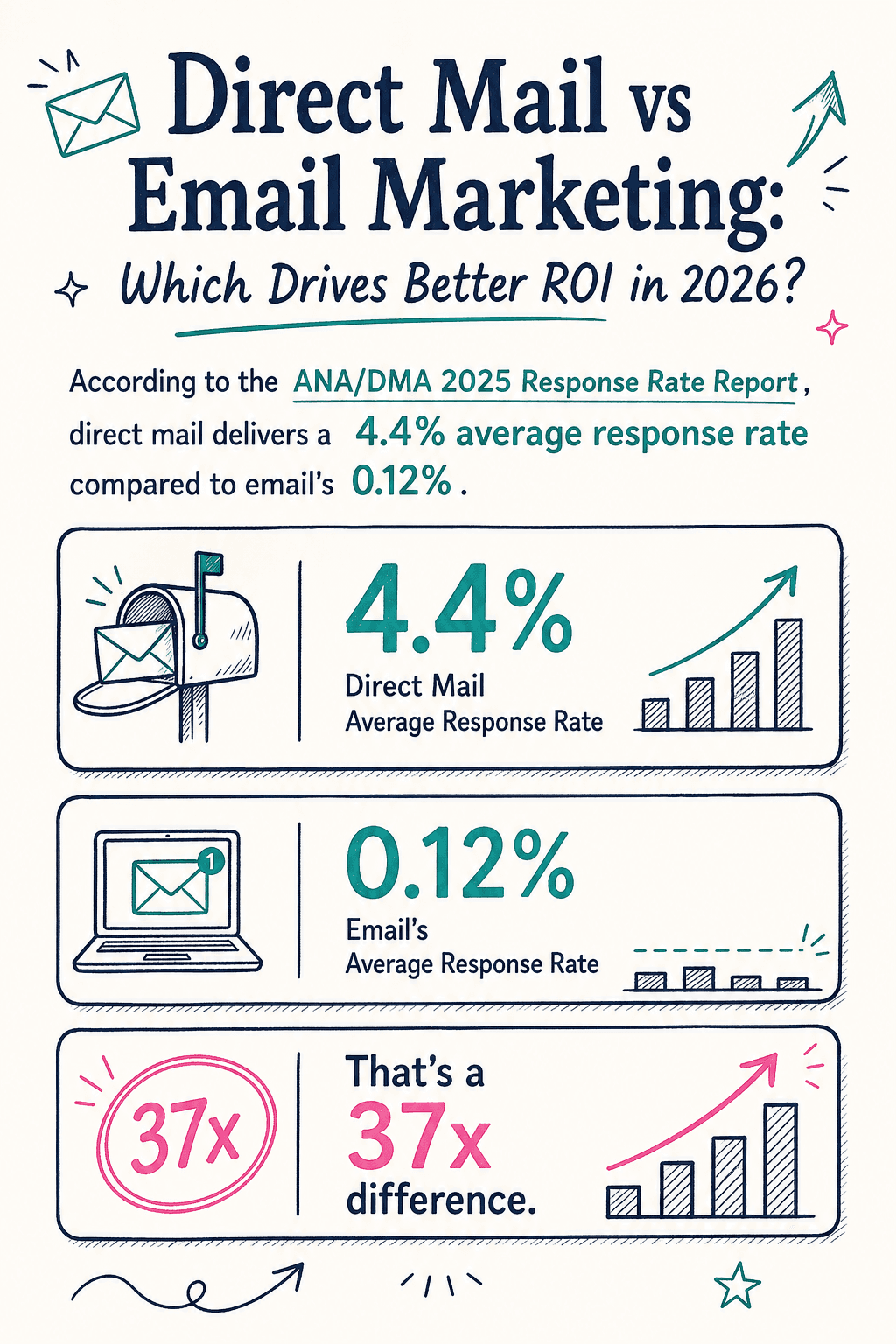
The takeaway: direct mail wins on engagement and response, while email wins on cost-per-send. But ROI — the metric that actually matters — favors direct mail, especially for high-value products and services.
Response Rates: Why Direct Mail Dominates
The 37x response rate gap isn't a fluke. It's driven by three factors that aren't going away anytime soon:
1. Physical Mail Has Less Competition
The average office worker receives over 120 emails per day (Lob). Meanwhile, the average American household receives just 2–3 pieces of marketing mail daily. Less competition means more attention per piece.
2. Tangibility Creates Trust
Neuroscience research from USPS and Temple University found that physical mail activates more areas of the brain associated with memory and emotional response than digital content. People process physical media differently — it feels more "real" and trustworthy.
3. Direct Mail Gets Opened
With an 80–90% open rate, direct mail blows past email's 20–30% average. And 84% of consumers read direct mail the same day they receive it. Your message actually gets seen.
For B2B teams running handwritten note campaigns for sales, these response rates climb even higher. Personalized, handwritten direct mail generates a 6.5% response rate compared to 2% for generic printed pieces (ANA/DMA).
ROI Breakdown: The Real Cost of Each Channel
Email's biggest advantage is cost. Sending 10,000 emails might cost $100–$500 depending on your platform. Sending 10,000 direct mail pieces? That's $5,000–$35,000 depending on format and personalization.
But ROI isn't about cost — it's about return relative to cost. And here's where the math gets interesting:
Email Marketing ROI
$36 return per $1 spent (Litmus, 2024 State of Email)
Best for: nurture sequences, newsletters, transactional messages, re-engagement
Works at scale with minimal incremental cost
Weakness: declining open rates, spam filters, inbox fatigue
Direct Mail ROI
$42 return per $1 spent (ANA/DMA, 2024 Response Rate Report)
Best for: high-value prospecting, account-based marketing, customer retention, win-back campaigns
Higher cost per piece, but higher conversion value
Weakness: slower delivery, higher upfront investment, harder to A/B test at scale
The key insight: when your average deal value exceeds $200, direct mail's higher cost per piece becomes negligible compared to its conversion advantage. For B2B companies where deal sizes are in the thousands, direct mail ROI compounds dramatically.
When to Use Email Marketing
Email isn't going anywhere — and it shouldn't. It's the backbone of most marketing stacks for good reason:
Lead nurturing: Automated drip sequences that educate prospects over weeks or months
Transactional communication: Order confirmations, shipping updates, account notifications
Content distribution: Newsletters, blog roundups, product updates
Re-engagement: Win-back sequences for dormant contacts
Scale: When you need to reach 50,000+ contacts affordably
Email excels at maintaining relationships at scale. It's fast to deploy, easy to automate, and the data feedback loop (opens, clicks, conversions) is immediate.
When to Use Direct Mail
Direct mail shines in scenarios where standing out matters more than reaching everyone:
Account-based marketing (ABM): Targeting high-value accounts with personalized outreach
Sales prospecting: Breaking through to decision-makers who ignore emails
Customer retention: Thank-you notes, anniversary cards, loyalty touchpoints
Event invitations: Physical invites have significantly higher attendance rates
Win-back campaigns: Re-engaging lapsed customers who've unsubscribed from email
The companies seeing the biggest direct mail ROI in 2026 are using handwritten card services that combine the personal touch of real pen-on-paper with the scalability of automated fulfillment. A handwritten note from a sales rep feels personal. The fact that it can be triggered automatically from your CRM at scale? That's the competitive edge.
The Multichannel Advantage: Using Both Together
Here's the real answer to "direct mail vs email marketing": don't choose. The data overwhelmingly supports using both.
Campaigns that combine direct mail with digital follow-up see a 118% lift in response rate compared to digital-only campaigns (Merkle). And 97% of marketers say integrating direct mail with digital channels has a positive impact on performance.
Here's a proven multichannel sequence for B2B prospecting:
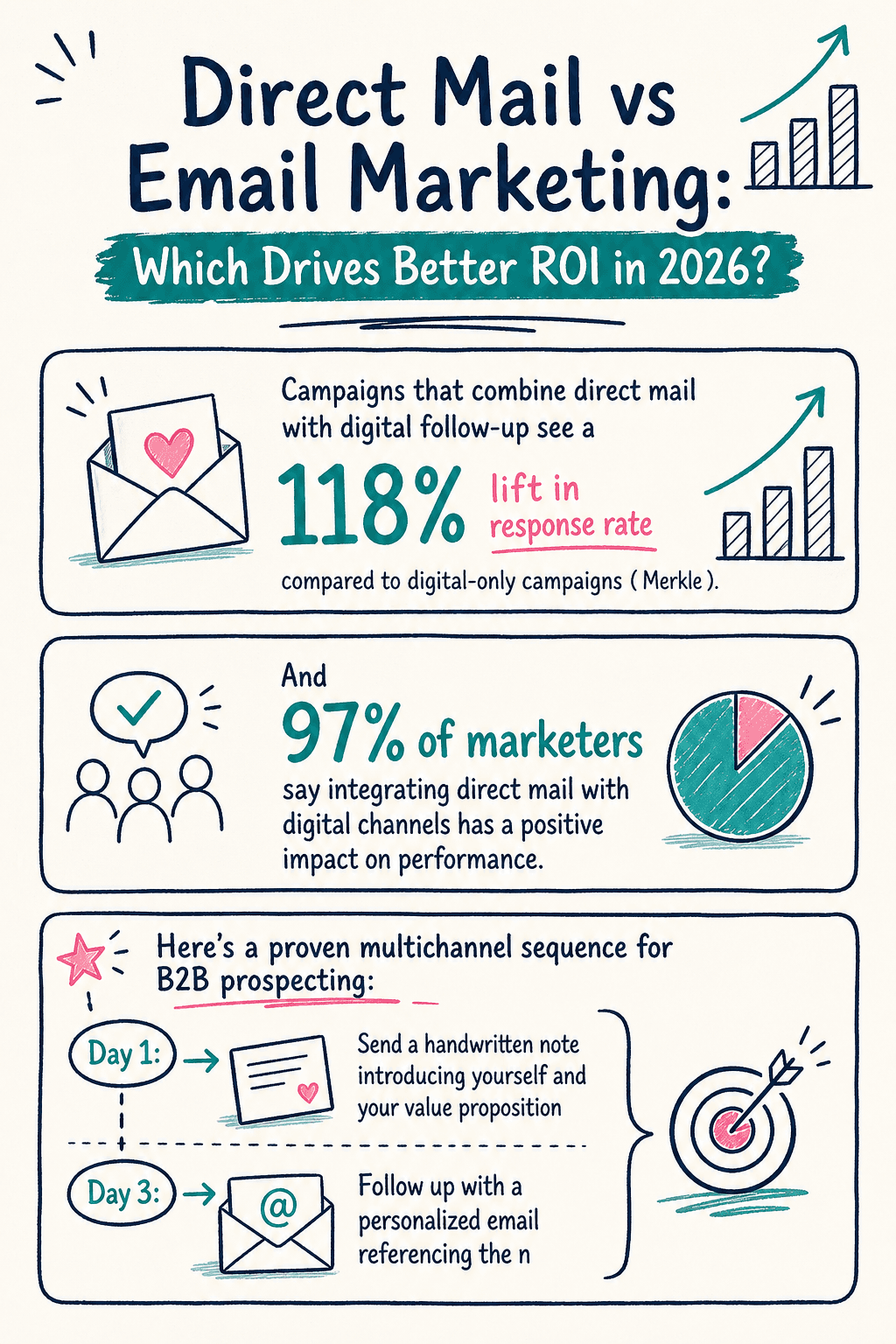
Day 1: Send a handwritten note introducing yourself and your value proposition
Day 3: Follow up with a personalized email referencing the note
Day 7: Connect on LinkedIn with a brief message
Day 10: Send a second email with a case study or relevant resource
Day 14: Call the prospect — by now, they've seen your name 4 times
This approach works because it leverages the mere exposure effect: people develop preferences for things they encounter repeatedly. Direct mail creates the initial memorable touchpoint, and digital channels reinforce it.
Using both channels together can increase customer spending by up to 25% compared to single-channel approaches (Lob).
Cost Comparison: Real Numbers for 2026
Let's get specific about what each channel actually costs to run:
Email Marketing Costs
Platform fees: $20–$500/month depending on list size (Mailchimp, HubSpot, etc.)
Cost per email: Less than $0.05 per send
Design/copywriting: $200–$1,000 per campaign (if outsourced)
Total for 1,000-person campaign: $50–$200
Direct Mail Costs
Printed postcards/letters: $0.50–$2.00 per piece (including postage)
Handwritten cards: $1.40–$3.50 per card depending on volume (Scribble pricing starts at $3.50 for single cards, dropping to $1.40 at 10,000+ volume)
Postage: $0.53–$0.78 per piece (USPS First Class)
Total for 1,000-person campaign: $1,400–$4,280 (handwritten) or $530–$2,780 (printed)
Yes, direct mail costs more per send. But remember the response rate difference: at 4.4% vs 0.12%, you need to send 37 emails for every 1 direct mail piece to get the same number of responses. When you factor in the quality of those responses — direct mail respondents convert at higher rates and spend more — the cost gap narrows significantly.
How Handwritten Direct Mail Changes the Equation
Not all direct mail is created equal. A glossy printed postcard and a handwritten note are both "direct mail," but they perform very differently.
Personalized, handwritten direct mail generates a 6.5% response rate — nearly 50% higher than the 4.4% average for all direct mail formats (ANA/DMA). Why? Because handwritten mail signals effort, authenticity, and personal attention in a way that printed mail simply can't.
Modern handwritten card services like Scribble use real pens (not printed fonts that mimic handwriting) to create genuinely handwritten cards at scale. Key features that make this practical for B2B teams:
Real pen-on-paper: 7 handwriting styles that look authentically human
Scalable: From single cards to 10,000+ campaigns
QR tracking: Individual QR codes (+$0.45/card) so you know exactly who engaged
CRM integration: Available for orders over 1,000 units — trigger cards automatically from your sales workflow
No subscription: Pay only for the cards you send
The combination of genuine handwriting, beautiful card design, and measurable tracking closes the gap between direct mail's high engagement and email's data-driven optimization.
5 Industries Where Direct Mail Outperforms Email
While both channels work across industries, direct mail has a particularly strong edge in these sectors (Postalytics, Modern Postcard):
Real estate: Neighborhood farming with handwritten "just listed" notes outperforms email drips for listing leads
Financial services: Trust-dependent purchases benefit from the credibility of physical mail (response rates up to 5.1%)
SaaS/B2B tech: Account-based marketing with handwritten outreach cuts through crowded inboxes of decision-makers
Healthcare: Patient retention and appointment reminders see 3.4–4.1% response rates via mail
Luxury goods: High-end buyers expect premium touchpoints — luxury direct mail sees 56% higher response rates than average
In each case, the common thread is high customer lifetime value. When a single customer is worth thousands or tens of thousands of dollars, the $1.40–$3.50 cost per handwritten card is trivial.
Measuring Success: KPIs for Each Channel
One advantage email has over traditional direct mail is measurability. But that gap is closing fast with tools like QR tracking and personalized landing pages.
For email, track open rates (pixel tracking), click-through rates (link tracking), and revenue attribution (UTM parameters). A/B testing is fast and cheap at scale.
For direct mail, use QR codes, personalized URLs (PURLs), and unique promo codes to track response rates and revenue. Matchback analysis connects mail recipients to downstream conversions.
For the most accurate comparison, track both channels through the same conversion funnel. Use unique landing pages or promo codes for direct mail so you can attribute revenue with the same precision as email.
If you're a real estate professional, check out our complete guide to direct mail for real estate agents for industry-specific strategies, cost breakdowns, and a step-by-step farming playbook.
For a practical checklist you can use on every campaign, see our 15 direct mail marketing tips for B2B teams.
The Bottom Line: Which Should You Choose?
If you're looking at the latest direct mail statistics, the answer is clear: both channels have a place in your marketing mix, but they serve different purposes.
Choose email when: You need speed, scale, and affordability. Email is unbeatable for nurture sequences, content distribution, and maintaining relationships with large audiences at minimal cost.
Choose direct mail when: You need to stand out, build trust, and drive high-value conversions. Direct mail is the better choice for ABM, sales prospecting, customer appreciation, and any campaign where the cost per piece is justified by the deal value.
Choose both when: You want the best results. The 118% response rate lift from multichannel campaigns isn't a nice-to-have — it's a competitive advantage that compounds over time.
The marketers winning in 2026 aren't choosing between direct mail and email. They're building integrated campaigns that use email's speed and scale alongside direct mail's tangibility and trust. And with handwritten card services making personalized direct mail more accessible and trackable than ever, the barrier to entry has never been lower.
Ready to add handwritten direct mail to your marketing mix? See how Scribble helps B2B teams generate more leads with real, handwritten cards at scale.