67 Direct Mail Statistics That Prove Physical Mail Still Works in 2026
The latest direct mail statistics on response rates, ROI, and trends — plus handwritten mail data no one else covers. Updated for 2026 with real sources.

67 Direct Mail Statistics That Prove Physical Mail Still Works in 2026
Last month, a VP of Sales told me direct mail was "dead." I pulled up his team's email campaign from Q4 — a 0.12% response rate on 40,000 sends. Then I showed him the latest ANA data: direct mail averages a 4.4% response rate. That's 37 times higher. He stopped talking about dead channels pretty quickly.
I spend a lot of my time at Scribble helping businesses build direct mail campaigns — specifically handwritten mail campaigns — and I've learned that most marketers aren't ignoring direct mail because they've tested it and it failed. They're ignoring it because they assume it doesn't work anymore. The data says the opposite.
These 67 direct mail statistics are sourced from the ANA/DMA Response Rate Reports, USPS filings, Lob's 2025 State of Direct Mail research, peer-reviewed neuroscience studies, and industry benchmarks. Every stat has a source you can verify. I've organized them into categories so you can find exactly what you need — whether you're building a business case, planning a campaign, or trying to convince your CFO that physical mail deserves a budget line.
Direct Mail Response Rate Statistics
Response rate is where direct mail makes its strongest case. These numbers aren't marginal improvements over digital — they're a fundamentally different order of magnitude.
1. Direct mail has an average response rate of 4.4% — 37 times higher than email's 0.12%. This is the headline stat from the ANA/DMA 2025 Response Rate Report, and it's the single most important number in this article. If you remember nothing else, remember this one.
2. House list direct mail campaigns achieve a 9% average response rate. When you're mailing to people who already know your brand — existing customers, past buyers, warm leads — response rates roughly double compared to prospect lists (Postalytics).
3. Prospect list direct mail achieves a 4.9% response rate. Even cold outreach via direct mail significantly outperforms email, paid social, and display advertising on a response-rate basis (ANA/DMA).
4. Oversized envelopes generate the highest response rate among direct mail formats. The ANA found that oversized envelopes outperform postcards (5.7%), letter-sized envelopes (4.3%), and catalogs (3.5%) (ANA/DMA).
5. Healthcare leads all industries with a 4.09% direct mail response rate. Financial services follows at 3.95% and automotive at 3.84%. Industries with longer, more considered purchase cycles tend to see the strongest direct mail performance (ANA/DMA 2025).
6. 62% of consumers who responded to direct mail made a purchase. Response doesn't just mean "opened it." Nearly two-thirds of people who engage with a direct mail piece follow through with their wallet (Postalytics).
7. Adding a recipient's name to direct mail increases response rates by 135%. Basic personalization — just a name — more than doubles your response rate. This is the easiest lift in all of marketing (PostcardMania).
8. 81% of consumers take action after receiving direct mail — up from 60% in 2024. That 21-percentage-point jump in a single year is remarkable. Direct mail isn't just holding steady — it's accelerating (Lob 2025 Consumer Insights).
9. Response rates jump to 27% when direct mail is combined with email. Multi-channel campaigns don't just add — they multiply. A coordinated mail-plus-digital approach nearly 6x the response rate of mail alone (Postalytics).
In my experience, the response rate gap between direct mail and digital is actually wider than these averages suggest for certain use cases. I've seen B2B campaigns at Scribble — particularly handwritten card campaigns targeting decision-makers — pull response rates north of 15%. When you're reaching someone who gets 200 emails a day but maybe two pieces of real mail, the math is pretty straightforward.
Direct Mail ROI Statistics
Response rates tell you people are paying attention. ROI tells you it's worth the money.
10. Direct mail generates a 161% ROI when sent to house lists. That's the highest ROI of any marketing channel measured in the ANA/DMA 2025 Response Rate Report — beating email (44%), paid social (21%), and digital display (23%).
11. Direct mail produces an average return of $42 for every $1 spent. The DMA has tracked this metric for years, and it consistently outperforms digital channel benchmarks (ANA/DMA).
12. Direct mail leads generate 509% more revenue than digital leads. A PostcardMania analysis of 115,393 leads in 2024 found that leads originating from direct mail closed at dramatically higher values than those from digital channels (PostcardMania).
13. 79% of executives rank direct mail as their best-performing marketing channel. Not "one of" — the best. Even as costs rise, the performance gap keeps direct mail at the top of the stack (Lob 2025 State of Direct Mail).
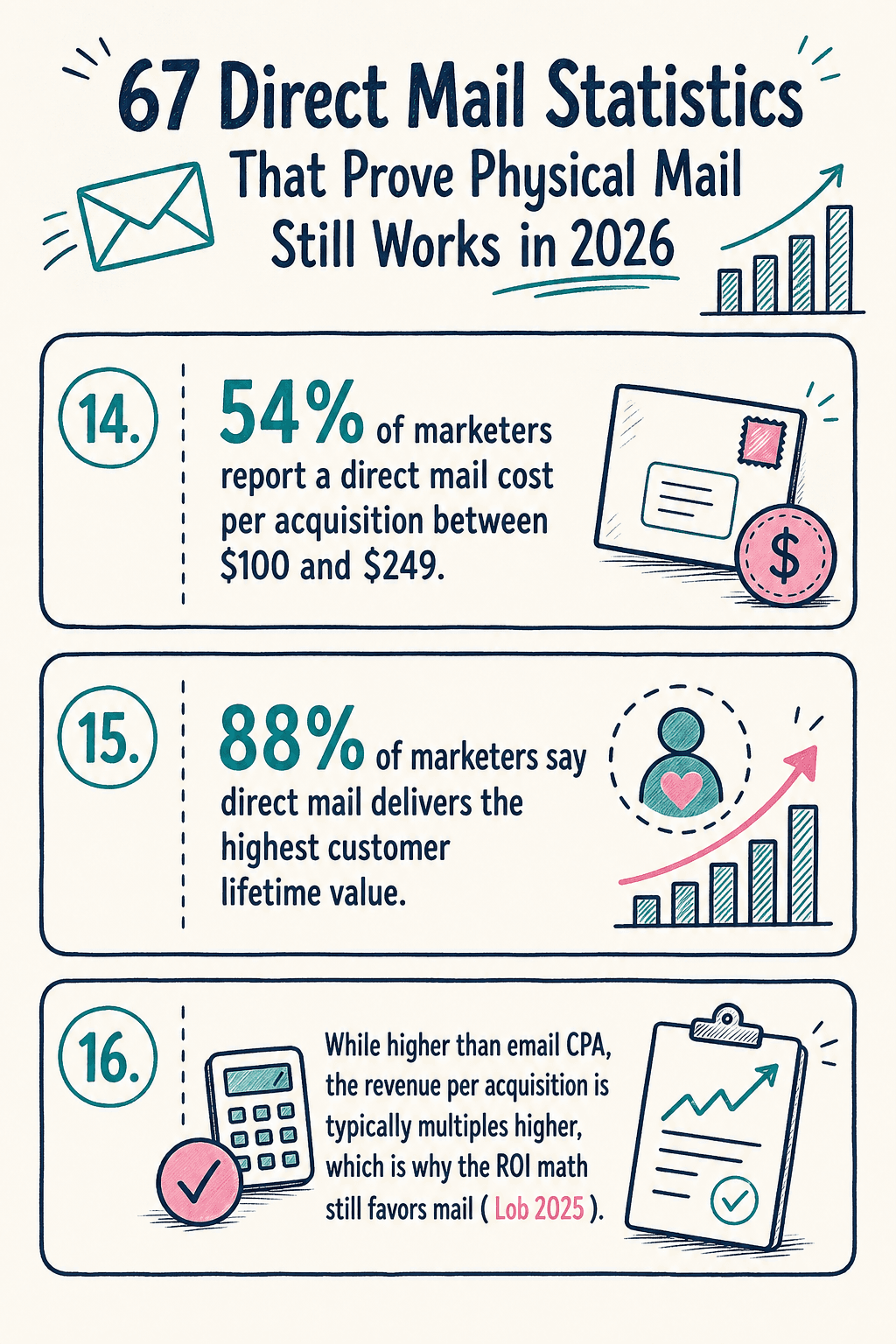
14. 54% of marketers report a direct mail cost per acquisition between $100 and $249. While higher than email CPA, the revenue per acquisition is typically multiples higher, which is why the ROI math still favors mail (Lob 2025).
15. 88% of marketers say direct mail delivers the highest customer lifetime value. Direct mail customers don't just convert — they stick around. The channel's ability to build genuine relationships translates into retention and repeat purchases (Modern Postcard).
16. Coordinating direct mail with digital channels increases conversion rates by 28% and brand recall by 75%. Direct mail doesn't compete with your digital strategy — it supercharges it (Postalytics).
Handwritten Mail Statistics
This is the section I care most about — and the one you won't find on any other statistics page. Handwritten mail is a category within direct mail that performs at a completely different level. It's the core of what we do at Scribble, and the data explains why.
17. Handwritten mail achieves a 99% open rate. When a handwritten envelope lands on someone's desk, they open it. Every time. Compare that to email's 20-30% open rate or even standard direct mail's 42% (Simply Noted).
18. Hand-addressing envelopes increases response rates by 300%. A study cited by LettrLabs found that the simple act of handwriting the recipient's address on the envelope — before they even see the contents — triples the response rate (LetterFriend).
19. Handwritten direct mail generates 300% higher ROI than printed alternatives. The combination of higher open rates, higher response rates, and stronger emotional engagement compounds into dramatically better returns (LetterFriend).
20. Customers who receive a handwritten note spend 100.5% more on their next purchase. This comes from a peer-reviewed field experiment published in the Journal of Interactive Marketing — the gold standard. Machine-printed notes had zero effect.
21. Handwritten Post-it notes attached to mailings increase response rates by 76%. Even a small handwritten element — a sticky note with a short message — dramatically lifts engagement with the entire mail piece (LetterFriend / TMR Direct).
22. In an American Heart Association test of 25,000 mail pieces, handwritten envelopes increased response rates by 346%. This wasn't a small sample. Twenty-five thousand pieces, head-to-head, with a nearly 3.5x lift from handwriting alone (Scribe Handwritten).
23. 74% of consumers say they feel more valued receiving a handwritten note than a generic email or text. The perceived effort behind handwriting triggers a fundamentally different emotional response in the recipient (Audience).
24. Handwritten thank-you notes to first-time customers increase repeat purchases by 25%. An online retailer that implemented handwritten post-purchase notes saw a measurable lift in both repeat purchase rates and positive reviews (LettrLabs).
For DTC brands looking to put these numbers to work, our guide to direct mail for e-commerce covers the five highest-impact use cases and how to execute them.
25. Photocopied handwritten notes are equally effective as hand-delivered originals. The Kim et al. 2022 study found that the perception of handwriting effort matters — not whether the writer's hand touched that specific card. This is why scaled handwriting services work (Journal of Interactive Marketing).
26. Handwritten communications in the nonprofit sector show 45% higher second-gift conversion rates and 28% larger gift sizes. For organizations that depend on donor retention, handwritten outreach isn't a nice-to-have — it's a revenue driver (Scribeless).
I'll be honest — the handwritten mail data is the reason I do what I do at Scribble. When you see a 99% open rate and a 300% response rate lift, you stop wondering whether physical mail matters and start wondering why every business isn't doing this. The answer, usually, is that they think it can't scale. It can. That's the whole point of what we build. For teams ready to act on these numbers, our lead generation solution turns these statistics into qualified pipeline.
Direct Mail vs Digital Marketing Statistics
The "direct mail vs email" question comes up in every conversation I have with marketing teams. Here's what the data actually shows — it's not even close.
27. Direct mail open rates range from 80-90%, compared to 20-30% for email. The physical format advantage is enormous: mail sitting on a desk gets picked up. An email in an inbox with 47 unread messages does not (Postalytics).
28. 96% of all mail was engaged with by recipients. According to a USPS study, virtually all delivered mail gets at least a glance — a reach metric no digital channel can match.
29. Direct mail is 49% more memorable and 33% more engaging than email marketing. Neuroscience research using brain imaging has consistently shown that physical media creates stronger memory traces than screen-based content (Postalytics).
30. 75% of people can recall a brand after receiving direct mail, compared to 44% for digital ads. Brand recall is nearly double. For companies that depend on being remembered when the purchase decision happens, this is a decisive advantage (UPrinting).
31. Direct mail captures 132 seconds of undivided attention, compared to 13.8 seconds for a TV ad. Over two minutes of focused engagement. That's enough time to read, absorb, and act on a message — something a banner ad or pre-roll video simply cannot achieve (Postalytics).
32. The average lifespan of a direct mail piece is 17 days, compared to 17 seconds for an email. Mail sits on desks, gets pinned to bulletin boards, gets shown to colleagues. Emails get archived or deleted within moments of arrival (UPrinting).
33. 58% of consumers feel overwhelmed by digital brand messages. In contrast, 53% say direct mail feels "more special, valuable, or exclusive." Digital fatigue is real, and it's pushing consumers toward physical channels (Lob 2025 Consumer Insights).
34. 97% of marketers say integrating direct mail with digital efforts positively impacts performance — up 7% from 2024. The question isn't mail or digital. It's mail and digital. Nearly every marketer who's tried the combination reports better results (Lob 2025).
35. Marketing campaigns combining direct mail and digital see a 118% lift in response rate. More than double the response when you pair a physical touchpoint with digital follow-up (Postalytics).
36. 73% of American consumers prefer brands to contact them via direct mail. Consumers actively prefer physical mail because they can read it on their own terms — no notifications, no pop-ups, no algorithmic feed manipulation (UPrinting).
The Neuroscience of Direct Mail
This is the section that explains why the response rate numbers are so much higher. It's not just about format preference — it's about how your brain processes physical versus digital information.
37. Physical mail requires 21% less cognitive effort to process than digital media. A Canada Post neuroscience study conducted by True Impact using EEG and eye tracking on 270 participants found that direct mail is literally easier for your brain to understand.
38. Direct mail produces a 20% higher motivation response than digital media. The same Canada Post/True Impact study found that physical mail doesn't just get attention — it drives action more effectively at a neurological level (True Impact).
39. 60% of respondents said direct mail keeps a brand top of mind. The True Impact research confirmed what the recall statistics suggest: physical mail creates persistent mental associations that digital struggles to replicate (True Impact).
40. Physical mail activates brain areas responsible for long-term memory encoding more strongly than digital media. A Temple University study partnered with the USPS OIG used neuroimaging to demonstrate that print ads create deeper memory traces — even when subjects reported similar interest levels across formats.
41. Consumers who see a direct mail piece before a cohesive social media ad show 44% stronger long-term memory encoding. MarketReach neuroscience research found that physical mail primes the brain for subsequent digital touchpoints, making the entire marketing mix more effective (Design Distributors).
42. Physical mail triggers stronger emotional responses than digital content. The Temple University/USPS study found that participants showed measurably more intense emotional reactions to physical ads and remembered the content more effectively than digital equivalents (USPS OIG).
I find these neuroscience stats particularly useful when talking to data-driven marketers who want to understand mechanism, not just outcome. Direct mail doesn't just perform better — there's a biological explanation for why it performs better. Your brain processes physical objects differently than pixels on a screen. That's not going to change with the next algorithm update.
Direct Mail Demographics and Audience Statistics
One of the biggest misconceptions about direct mail is that it's a channel for older demographics. The data tells a completely different story — and it's a story that should make every marketer rethink their assumptions.
43. 85% of Gen Z and Millennials engage with direct mail. Not boomers. Not retirees. The demographics that supposedly live exclusively on their phones are actively reading, sharing, and acting on physical mail (Lob 2025 Consumer Insights).
44. The 18-21 age group has a 12.4% direct mail response rate — the highest of any demographic. This stat consistently surprises people. The youngest adult consumers respond to direct mail at 3x the overall average (ANA/DMA).
45. 67% of Gen Z and Millennials have made a purchase or signed up for a service after receiving direct mail. These aren't passive opens — they're conversions. Two-thirds of younger consumers are taking real commercial action from physical mail (Lob 2025 Consumer Insights).
46. 80% of Gen Z share direct mail with others. Mail is becoming a social, shareable experience for younger consumers. For brands, that means organic amplification beyond the initial recipient (Lob 2025 Consumer Insights).
47. 92% of Millennials say they are influenced by direct mail when making purchasing decisions. That's higher than the 78% influenced by email. Physical mail has more persuasive power among Millennials than the channel most marketers rely on exclusively (Taradel).
48. 82% of Millennials view print advertisements as more trustworthy than digital ads. In an era of ad fraud, deepfakes, and bot traffic, the tangibility of physical mail signals legitimacy in a way that screens cannot (Taradel).
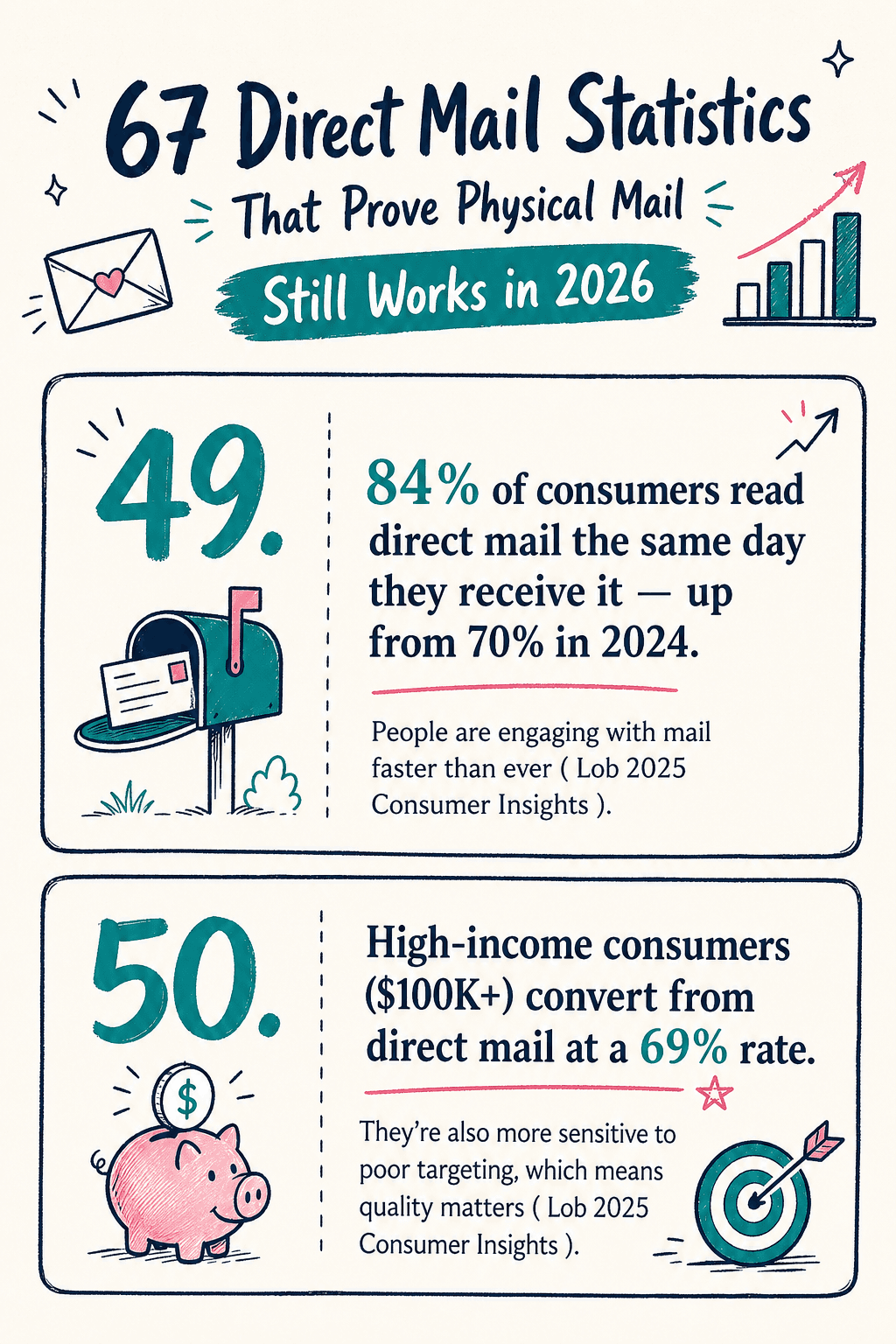
49. 84% of consumers read direct mail the same day they receive it — up from 70% in 2024. Immediacy is increasing, not decreasing. People are engaging with mail faster than ever (Lob 2025 Consumer Insights).
50. High-income consumers ($100K+) convert from direct mail at a 69% rate. The audience that matters most to high-ticket B2B and premium consumer brands converts at the highest rate. They're also more sensitive to poor targeting, which means quality matters (Lob 2025 Consumer Insights).
51. 86% of consumers say they genuinely like receiving direct mail. Not "tolerate." Not "don't mind." Like. That's a consumer sentiment score most digital channels can only dream of (Lob 2025 Consumer Insights).
Direct Mail Trends and Volume Statistics
The macro picture matters. Here's where the direct mail industry stands in 2026 — how much is being sent, how much is being invested, and where the trajectory is heading.
52. The global direct mail advertising market is expected to reach $73.57 billion in 2026. Despite the narrative of "mail is dying," the market continues to grow — albeit at a modest 0.3% CAGR (Modern Postcard).
53. USPS total mail volume was 108.7 billion pieces in FY2025 — a 3.3% decline from the prior year. Volume is declining, but the revenue per piece is increasing as marketers shift toward more targeted, higher-value mail formats (USPS).
54. USPS Marketing Mail revenue increased 2.3% ($350 million) in FY2025 despite a 1.3% volume decline. Marketers are spending more per piece — investing in better formats, better personalization, and better targeting. The revenue growth amid volume decline tells the real story: quality is winning (USPS).
55. 84% of marketers plan to increase their direct mail budget in the next 12 months. The investment trend is decisive. The vast majority of marketers aren't cutting mail — they're doubling down (Modern Postcard).
56. Companies plan to double their direct mail volume from an average of 34.9 million pieces in 2024 to 67.3 million in 2025. This is the most aggressive growth signal in the Lob data — a near-100% planned increase in volume (Lob 2025).
57. Financial services marketers led all industries with a 47% year-over-year budget increase for direct mail. The sector with the most to gain from trust and personalization is investing the most aggressively in the channel that delivers both (Lob 2025).
58. 57% of marketers are mailing to winback/remarketing audiences monthly — up from 38% in 2024. Retention and reactivation are emerging as the primary use cases for direct mail, beyond just acquisition (Lob 2025).
59. The average household receives about 454 pieces of marketing mail per year — roughly 1-2 per day. Compare that to over 100 emails per day. The low volume of physical mail is actually its advantage: less competition for attention (UPrinting).
Direct Mail Personalization and Automation Statistics
The days of "Dear Occupant" are over. Modern direct mail is data-driven, CRM-integrated, and individually personalized — and the statistics show why that matters.
60. 67% of consumers take action when direct mail includes a personalized detail. In contrast, 72% toss mail that feels irrelevant. Personalization isn't a nice-to-have — it's the difference between conversion and the recycling bin (Lob 2025 Consumer Insights).
61. High-ROI marketers are 163% more likely to prioritize clean data for targeting. The correlation between data quality and direct mail success is enormous. Bad data doesn't just reduce returns — it actively damages your brand perception when irrelevant mail arrives (Lob 2025).
62. High-ROI marketers are 32% more likely to use automation in their direct mail programs. Manual, batch-and-blast direct mail is being replaced by triggered, event-driven mailings — just like email marketing evolved a decade ago (Lob 2025).
63. 52% of consumers expect direct mail to be personalized. The bar has been raised by digital personalization. Today's mail recipients expect the same level of relevance from physical mail that they get from their email inbox (PostcardMania).
64. 60% of Millennials are comfortable using QR codes on direct mail, compared to 26% of Boomers. For younger demographics, QR codes bridge physical mail to digital experiences seamlessly — enabling tracking, landing pages, and conversion measurement (Lob 2025 Consumer Insights).
This is the part of the data that gets me most excited. At Scribble, we build handwritten mail campaigns that integrate directly with CRMs — so every card is triggered by a real event (a demo booked, a deal closed, a client milestone) and personalized with real details. The automation stat is the one I point to when someone says, "We can't scale this." You absolutely can.
Direct Mail Consumer Sentiment Statistics
Numbers tell you what's happening. Sentiment tells you why — and whether the trend will last.
65. 49% of consumers say brands that send direct mail are more credible than those that rely solely on digital. Physical presence signals investment and legitimacy. In a world where anyone can buy a Facebook ad for $5, sending a real piece of mail signals that you're a real business (Lob 2025 Consumer Insights).
66. 81% of consumers say they're more likely to re-engage with a brand after receiving direct mail. For win-back and reactivation campaigns — the bread and butter of retention marketing — direct mail outperforms every digital re-engagement tactic in the playbook (Lob 2025 Consumer Insights).
67. 53% of consumers describe direct mail as "real, valuable, and worth keeping." That language — "worth keeping" — is the key. How many emails have you ever described as "worth keeping"? Exactly. Physical mail occupies a different category in consumers' minds (Lob 2025 Consumer Insights).
Key Takeaways
Sixty-seven statistics is a lot of data. Here's what it adds up to:
Response rates are not comparable. Direct mail at 4.4% versus email at 0.12% is a 37x difference. Handwritten mail pushes that further — 99% open rates, 300% response rate lifts, and doubled customer spending. These aren't marginal gains.
ROI favors direct mail decisively. A 161% ROI on house lists, $42 return per dollar spent, and 509% more revenue per lead. The cost-per-piece is higher than email, but the cost-per-result is often lower.
Younger demographics are the most engaged. The idea that direct mail is a boomer channel is flatly wrong. Gen Z has the highest response rate (12.4%), and 85% of Gen Z and Millennials actively engage with mail they receive.
Handwritten mail is the highest-performing format. Within direct mail, handwritten pieces outperform printed mail on every metric — open rates, response rates, ROI, and customer lifetime value. If you're going to invest in physical mail, handwriting is the format that justifies the investment most clearly.
The trend is accelerating. 84% of marketers are increasing their direct mail budgets. Consumer engagement jumped from 60% to 81% in a single year. This isn't a channel in decline — it's a channel in resurgence.
If you're considering adding handwritten mail to your sales outreach or building direct mail into your marketing mix, the data couldn't be clearer. The question isn't whether direct mail works. It's why you're not doing more of it.
Want to see what handwritten direct mail looks like at scale? Start a campaign with Scribble and see why the statistics play out the way they do.
If you're a real estate professional, check out our direct mail playbook for real estate agents for industry-specific strategies, cost breakdowns, and a step-by-step farming playbook.
Frequently Asked Questions About Direct Mail Statistics
What is the average response rate for direct mail?
The average direct mail response rate is 4.4% according to the ANA/DMA 2025 Response Rate Report. House list campaigns average 9%, while prospect list campaigns average 4.9%. Both significantly outperform email (0.12%), paid social (0.5-1.0%), and display advertising. Handwritten mail pushes response rates even higher, with studies showing lifts of 300% over printed formats.
Is direct mail still effective in 2026?
Yes — more effective than most marketers realize. Direct mail generates a 161% ROI on house lists, 81% of consumers take action after receiving mail (up from 60% in 2024), and 84% of marketers are increasing their direct mail budgets. The channel is experiencing a resurgence driven by digital fatigue and improved personalization technology.
How does direct mail ROI compare to email?
Direct mail ROI (161% on house lists) significantly exceeds email ROI (44%) according to the ANA/DMA 2025 data. Direct mail also generates $42 in return for every $1 spent. While cost per piece is higher than email, the dramatically higher response rates and conversion rates typically produce a lower cost per acquisition and higher revenue per lead.
What age group responds best to direct mail?
Consumers aged 18-21 have the highest direct mail response rate at 12.4%, according to ANA/DMA data. Lob's 2025 Consumer Insights report found that 85% of Gen Z and Millennials engage with direct mail, with 67% making a purchase or signing up for a service. The assumption that direct mail only works for older demographics is not supported by the data.
What is the open rate for handwritten mail?
Handwritten mail achieves a near-universal open rate of 99%, compared to 42% for standard printed direct mail and 20-30% for email. Hand-addressing envelopes alone increases response rates by 300%. The combination of perceived personal effort, tactile engagement, and scarcity — most people receive fewer than 10 handwritten pieces per year — drives this exceptional performance.