
A direct-mail program can help an agent stay in touch with a defined area or group of past clients. Start with a realistic annual budget and a useful reason for each contact. A mailing schedule does not guarantee listings.
This guide covers formats, current postal references and examples of how to plan a farm. It does not report results from a verified dataset of Scribble real-estate campaigns.
In this guide, I'll walk you through the exact strategies, formats, and economics that make direct mail one of the highest-ROI channels available to real estate professionals in 2026. Whether you're farming a neighborhood, following up with past clients, or prospecting expired listings, you'll leave with a system you can start running this month.
Why Direct Mail Still Works for Real Estate Agents
Real estate is a relationship business. People don't hire an agent based on a Google ad. They hire someone they trust, someone whose name they recognize, someone who feels like a neighbor rather than a salesperson.
That's where direct mail has an edge no digital channel can match.
Compare mail and email using the same audience and outcome. A reply, an appointment and a sale are different measures. The ANA’s 2023 Response Rate Report is one source of industry benchmarks; its full findings require a login. Use your own campaign results to set a realistic target.
But the numbers only tell part of the story. Here's why direct mail works so well for agents specifically:
Less competition in the mailbox. The average person receives 120+ emails per day but only 2 to 3 pieces of marketing mail. Your postcard doesn't compete with 50 other messages.
In USPS and Temple University research, participants remembered physical advertisements more readily than digital ads. The study did not measure handwritten-card open rates.
Mail stays in the home. A direct mail piece sits on the counter or fridge for an average of 17 days. Your email gets deleted in seconds.
It reaches people who aren't searching yet. Most homeowners don't Google "real estate agent" until they've already decided to sell. Direct mail reaches them months before that decision, positioning you as the obvious choice.
Direct Mail for Real Estate: The Numbers That Matter
Before we get into strategy, let's look at the data. Every number here comes from a published source (linked throughout).
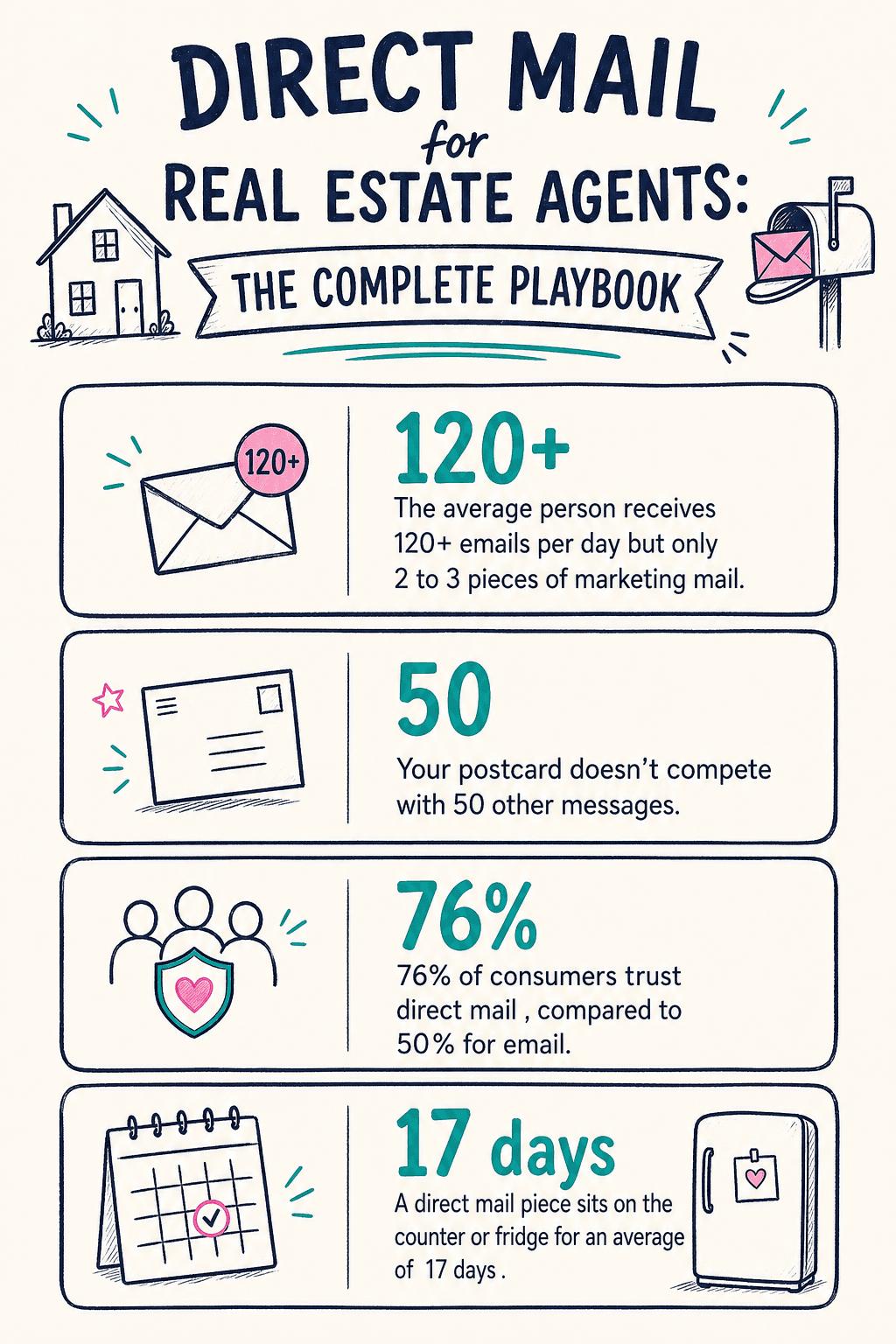
Here are the stats that matter most for agents:
Real-estate response rates depend on the farm, list and definition of a response. Treat the linked supplier guide as background, not a forecast or a controlled comparison with email. Further reading: Mail Processing Associates.
Scribble does not measure envelope opens. A mailed status cannot establish whether a homeowner received or read the card.
The linked vendor compilation describes an individual agent campaign. Without its full costs, attribution and comparison method, it should not be used as a typical ROI forecast. Further reading: REsimpli campaign example.
A card may be kept or discarded. This guide does not verify a fixed number of days in the home or a comparable email-attention duration.
Consumer-preference findings need the original survey, year and population. Do not apply an unverified percentage to homeowners in your farm. Further reading: prefer direct mail.
A purchase following a mailing does not by itself establish that mail caused it. Record qualified inquiries, signed clients and costs separately.
Work out the annual budget before sending. A $1,150 monthly program costs $13,800 over twelve months, before any omitted expenses. One commission covers that only if the amount you retain after splits and transaction costs is greater than the campaign cost.
Geographic Farming: The Foundation of Real Estate Direct Mail
Geographic farming means regularly contacting a defined area with useful local information. It is one approach to test, alongside maintaining relationships with past clients and responding to actual inquiries.
How to Choose Your Farm Area
Not every neighborhood makes a good farm. Here's what to look for:
Check recent transaction volume using data you are permitted to use. A neighborhood with 1,000 homes and 50 annual sales has an observed 5% turnover rate, but that alone does not establish that a mailing will pay for itself. Consider competition, reachable audience and your retained contribution per transaction.
Manageable size: choose a number of homes you can afford to contact and evaluate. The appropriate size depends on postal format, competition and budget; 500 or 2,000 homes is not a universal threshold.
Limited agent competition. If three other agents already dominate the area with established farming programs, pick a different neighborhood. You want to be the first consistent voice, not the fourth.
Alignment with your expertise. Farm where you live, where you've closed deals, or where you have genuine knowledge. Homeowners can tell when an agent knows the area versus when they're just carpet-bombing postcards.
How Often to Mail
Consistency matters more than frequency. But here are the benchmarks:
Choose a cadence that gives you a useful reason for contact and fits your budget. Monthly sending is one option to test, not an established optimum. Further reading: Most successful farming programs.
Quarterly is the minimum effective frequency. Any less and you lose the recognition you're building.
Set a review date and spending limit before the program begins. A long sales cycle may need a longer observation window, but there is no guaranteed payoff after six or twelve months.
5 Direct Mail Formats That Work for Real Estate
Different situations call for different formats. Here's when to use each one:
1. Just Listed / Just Sold Postcards
The most common format in real estate direct mail, and for good reason. A Just Sold postcard proves your competence to the neighborhood. It says: "I'm active here, I'm getting results, and I could do the same for you."
When to send: Within 7 days of a listing or sale, while the news is still timely.
Where to send: 200 to 500 homes surrounding the property.
Cost: obtain a current quote for design, printing, preparation and postage. Do not treat a vendor’s historical all-in range as the current USPS rate. Further reading: Mail Processing Associates.
2. Neighborhood Market Update Cards
Monthly market data for the farm area: median sale price, days on market, number of active listings, and price trends. This positions you as the informed expert, not just another agent with a logo.
Why it works: Homeowners care about their home's value. Data keeps them opening your mail every month.
Tip: Include one sentence of personal commentary on the data. "Homes in Oak Park are selling 12% faster than this time last year" is more compelling than a raw table.
3. Handwritten Notes
A handwritten letter can carry a personal follow-up, but its cost is usually higher than a mass-produced postcard. Compare the two formats using the same audience and measurement window; do not assume a 99% open rate or a response multiplier. Further reading: Handwritten letters.
Best use cases for handwritten notes in real estate:
Past client follow-up: Anniversary of their home purchase, holiday greetings, or a simple "thinking of you" note.
FSBO outreach: Explain why you are contacting the owner and what help you can offer. Respect their stated wishes, and measure responses rather than assuming a typical rate.
Expired listing prospecting: A personal, empathetic note (not a sales pitch) stands out from the avalanche of calls these sellers receive.
Sphere of influence nurturing: Keeping your network of past clients, friends, and referral partners warm.
Scribble writes your message with a real pen and mails the card for you. For a 500-person mailing, use the current credit prices to calculate your card budget. US postage is included. Measure replies and new listings in your own CRM before deciding whether to expand the campaign.
4. Event Invitation Mailers
Open houses, neighborhood events and home-valuation workshops can give you a reason to invite local residents. Compare registrations and attendance with your usual invitations; a physical format does not guarantee an increase.
Pro tip: Give recipients a short RSVP URL you control. An RSVP can tell you who responded; a page visit alone does not identify a person.
5. Holiday and Seasonal Cards
Holiday cards are a retention play, not a prospecting play. They keep you top of mind with past clients and referral sources. The key is to send them when nobody else does: Thanksgiving, 4th of July, or Valentine's Day stand out more than Christmas, when every agent sends a card.
The Real Estate Farming Playbook: 5 Steps
Here's the system I recommend to every agent who asks me about starting a farming program:
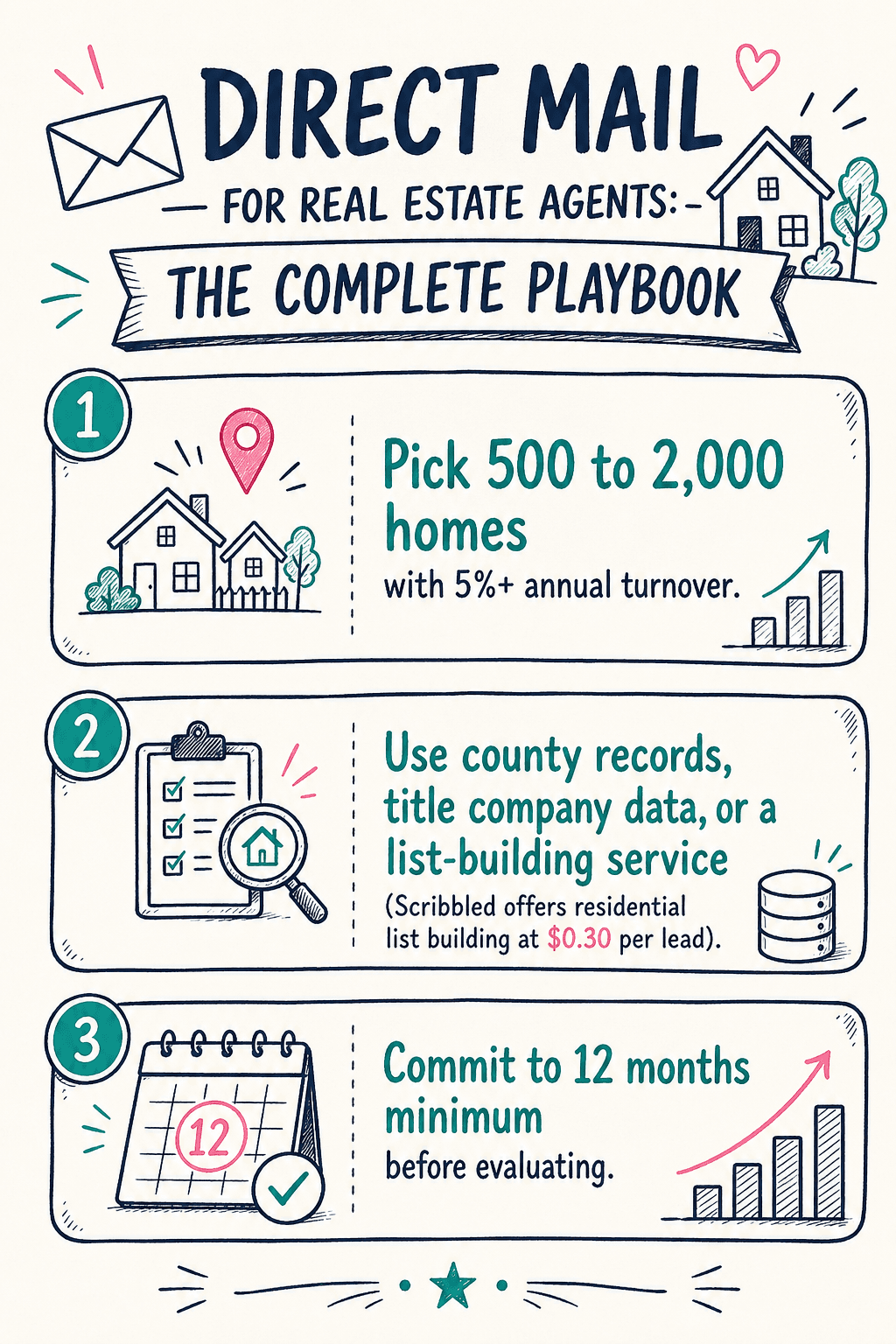
Choose your farm. Start with an area you know and a number of homes your budget can support. Review transaction history and competition before estimating potential business.
Build your list. County records and title company data can help you identify relevant homeowners. Keep the list focused on people you can help, and check addresses before mailing.
Choose a sustainable schedule and review results at the agreed point. Adjust or stop if the costs, response or recipient feedback do not justify continuing.
Mix your formats. Don't send the same postcard every month. Rotate between Just Sold cards, market updates, handwritten notes, and seasonal pieces. Variety keeps recipients paying attention.
Track and optimize. Use QR codes, unique phone numbers, or personalized landing pages to measure which formats and messages generate the most responses. Double down on what works.
What Does Real Estate Direct Mail Actually Cost?
Let's break down real numbers so you can plan your budget:
Postcard Campaigns (EDDM)
Production cost: request a quote for your size, quantity, paper and preparation requirements. Further reading: Mail Processing Associates.
Postage (EDDM Retail): USPS lists $0.26 per eligible piece as checked September 16, 2026. Verify the current rate and format before ordering. USPS EDDM requirements and rates.
All-in cost: add production, preparation and postage, plus list or creative expenses where applicable.
Illustrative postage for 1,000 eligible EDDM Retail pieces: 1,000 × $0.26 = $260, before printing and preparation.
Handwritten Card Campaigns
Scribble pricing (real pen on paper, handwritten envelope):
500 cards: multiply your current credit prices by 500. A standard card credit includes US postage.
1,000 cards: compare the available credit quantities and use the quoted total in your budget.
Order status: check card progress and arrival windows. Mailed means the card has been handed to USPS; it does not confirm delivery or that someone read it.
Add list preparation: request a current quote for the source, usage rights and address-quality work you need.
Is It Worth It?
Illustrative example: a $400,000 sale at an assumed negotiated 3% commission gives $12,000 gross commission before splits and costs. A $1,150 monthly mailing costs $13,800 annually. That one sale does not cover the annual campaign, even before those other costs. Commissions are negotiable; 3% is an example assumption.
Measure the number of additional clients attributable to your farm and the contribution you retain from their transactions. There is no verified general forecast of two to five extra listings or a 500% return here.
Tracking Your Results: QR Codes, Landing Pages, and CRM Integration
One of the biggest mistakes agents make with direct mail is failing to track results. "Where did you hear about me?" is not a reliable tracking method.
Here are three ways to measure what's actually working:
Campaign response: use a landing page or phone number you control, and record inquiries in your own CRM. Website visits and calls need their own measurement setup; they are separate from Scribble order status.
Dedicated landing pages. Create a unique URL for each campaign (e.g., yoursite.com/oak-park-values). This separates direct mail traffic from your other marketing.
CRM connections. Use a documented API or inbound-hook workflow for supported events, with no general 1,000-card requirement. Review the current named connector’s availability and monitor failed or skipped sends.
The agents getting the best results review their tracking data monthly and adjust their messaging, format, and targeting based on what the numbers show.
5 Mistakes That Kill Real Estate Direct Mail Campaigns
Check these common planning problems before committing the budget:
Continuing without a review point. Agree on the budget and decision rule before mailing. A longer program can create more opportunities for contact, but it also costs more and has no guaranteed return.
Mailing without a system. Random postcards sent whenever you remember don't build recognition. Set a calendar, automate your sends, and commit to a consistent schedule.
Generic messaging. "Your neighborhood expert" printed on a stock postcard tells people nothing. Lead with data, local knowledge, and genuine value. If your postcard could be from any agent in any city, it won't generate responses.
Targeting an area without checking the economics. Turnover is one input; competition and contribution after splits also matter. A fixed turnover threshold cannot guarantee a profitable farm.
Not tracking results. If you can't measure which campaigns generate calls and listings, you can't optimize. Every piece should have a QR code, unique URL, or dedicated phone number.
Frequently Asked Questions
How much should a real estate agent spend on direct mail?
Set the budget from available cash and the contribution needed to break even. Include all months of the program; a single listing does not automatically cover a year of mailings.
What is the best type of direct mail for real estate?
Different formats have different costs and space for a message. A postcard may fit a broad local update, while a card may fit a personal follow-up. Compare the result for your audience; there is no verified universal three-to-five-times response multiplier here.
How long does it take for real estate direct mail to work?
The time needed to evaluate a program depends on the transaction cycle and the number of relevant outcomes. Track costs and inquiries along the way and use a predetermined review point. Do not treat twelve months of mailing as a promise of stronger returns.
Is EDDM worth it for real estate agents?
Every Door Direct Mail reaches eligible postal routes without selecting individual named recipients. USPS lists EDDM Retail postage at $0.26 per piece as checked September 16, 2026. Check dimensions, preparation and quantity rules; printing and preparation are additional.
Direct mail works across industries, not just real estate. Nonprofits use handwritten cards to increase donor retention and turn one-time gifts into recurring support.
What response rate should I expect from real estate direct mail?
There is no single reliable response rate for every real-estate mailing. Separate cold farms, past clients and specific inquiries, and define whether you are counting a reply, appointment or signed client. Further reading: Mail Processing Associates.
For a practical checklist you can use on every campaign, see our 15 proven direct mail tips.
Start Your Direct Mail Program This Month
Choose an area you know, a message that gives residents useful information and a budget you can afford to evaluate. One listing does not automatically pay for a year of farming. Compare the contribution retained from additional business with the complete campaign cost.
The agents who succeed with direct mail treat it as a system, not a one-off experiment. They show up in the mailbox every month, they mix their formats to keep things interesting, and they use the data to guide their decisions.
If you add handwritten notes to a farming program, start with a relevant small group and measure qualified replies and costs. A physical sample can help you choose the format. Further reading: Related Scribble guide.
For tips on what to write in those notes, see our guide to real estate thank you notes - with templates for every stage of the deal.
Ready to plan a mailing? See how sending cards to a list works in Scribble.