Direct Mail ROI: How to Measure It and Why Handwritten Mail Outperforms
Direct mail averages 35% ROI and a 4.4% response rate. Handwritten mail pushes those numbers higher. Here is how to measure your direct mail ROI accurately and what benchmarks to target.
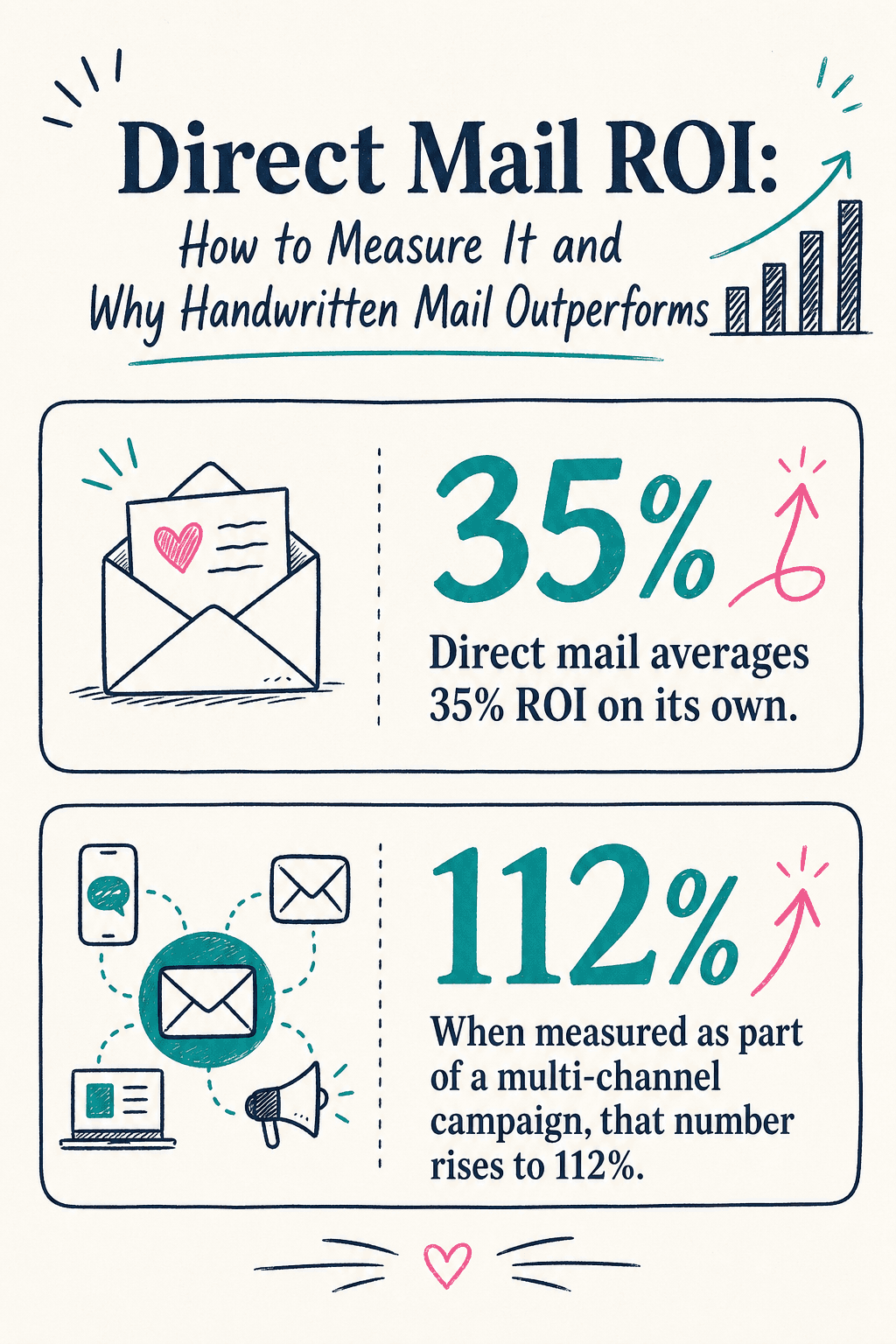
Direct mail averages 35% ROI on its own. When measured as part of a multi-channel campaign, that number rises to 112%. Those are not small numbers. They are larger than most digital channels, and they are achieved by a medium that many marketers have written off.
I've talked to enough marketing teams to know how this conversation usually goes. Direct mail is expensive. It's hard to measure. It doesn't scale. All of those objections are either wrong or solvable, and the teams that have solved them are generating returns that would make most email marketers uncomfortable.
This post covers how to calculate direct mail ROI accurately, what benchmarks to measure against, and why handwritten mail consistently outperforms standard direct mail on every metric that matters.
How to Calculate Direct Mail ROI
The basic formula is straightforward. ROI equals revenue generated minus campaign cost, divided by campaign cost, expressed as a percentage. The harder part is attribution -- connecting responses and revenue to the specific mail piece that drove them.
Direct mail ROI = ((Revenue from campaign - Cost of campaign) / Cost of campaign) x 100
A campaign costing $5,000 (500 pieces at $10 each including design, print, and postage) that generates $22,500 in revenue delivers an ROI of 350%. At a 4.4% response rate from 500 pieces, that's 22 responses. To hit $22,500, each closed response needs to be worth just over $1,000 -- a realistic number for most B2B sales.
The cost-per-piece calculation should include: design and copywriting, print and production, postage, list acquisition or CRM pull time, and any tracking setup (unique URLs, QR codes, promo codes). For more data on what these numbers look like across campaigns, see our roundup of direct mail statistics.
Attribution Methods for Direct Mail
Unique URLs and QR Codes
Assign a unique landing page URL or QR code to each campaign. Anyone who visits that URL or scans that code came from the mail piece. This is the most reliable attribution method and works for both online and offline response tracking.
Use vanity URLs that are easy to type (yourbrand.com/spring2026) rather than UTM-tagged URLs that are unreadable in print. The QR code can carry the full UTM string invisibly.
Unique Promo Codes
Each direct mail campaign gets a unique promo code. Any order using that code is attributed to the campaign. Simple, reliable, and easy to implement in any e-commerce or CRM system.
Promo codes also provide a built-in incentive to respond. Even a small discount, framed as exclusive to the mail recipient, increases response rate while enabling clean attribution.
Phone Tracking Numbers
For campaigns that drive phone responses, assign a unique phone number per campaign using a call tracking service. Every inbound call to that number is attributed to the direct mail piece.
Matched Mail/No-Mail Control Groups
The most rigorous attribution method. Split your list into two groups. Mail group A. Don't mail group B. Compare conversion rates over 90 days. The difference between the two groups is the incremental lift from the direct mail campaign.
This approach requires a list size large enough to be statistically significant. For smaller campaigns, promo codes or unique URLs are more practical. But for any team serious about measuring direct mail ROI accurately, matched control groups are the gold standard.
I've seen this methodology used consistently by the Scribble clients with the most sophisticated direct mail programmes. The lift numbers from these tests are almost always higher than expected -- because marketers underestimate how much direct mail is doing until they see what happens when it stops.
Direct Mail ROI Benchmarks
By Channel
Direct mail average ROI: 35% standalone, 112% cross-channel (Postalytics)
Email marketing average ROI: 36:1 (but on a much lower cost base)
Paid social average ROI: 20-30% in competitive categories
Paid search average ROI: varies by category, typically 200-400% in B2B at scale
The cross-channel number is the important one. Direct mail's strongest returns come when it works alongside email and digital channels. A prospect who receives a piece of direct mail and then sees a retargeted ad converts at a higher rate than either touchpoint alone.
By Response Rate
Non-personalised direct mail: 2% average response rate
Personalised direct mail: 4.4-6.5% average response rate
Trigger-based direct mail: 5-8% average response rate
Handwritten direct mail: 15-25%+ response rate (Scribble client data)
Response rate is not the same as ROI. A 15% response rate from 100 pieces to a high-value segment can outperform a 4% response rate from 10,000 pieces to a cold list. Match the format to the audience value. For more on how personalisation moves these numbers, see our guide to personalised direct mail.
By Campaign Type
Cold prospect acquisition: typically 1-5% response rate, ROI depends heavily on deal size
Win-back campaigns: 3-7% response rate, high ROI because cost of reacquisition is lower than new acquisition
Retention/loyalty campaigns: lower direct response rate but high LTV impact when measured at 12 months
Post-purchase follow-up: highest ROI of any campaign type when measured by repeat purchase rate
Why Handwritten Mail Outperforms Standard Direct Mail
Standard direct mail is opened at an 80-90% rate. Handwritten mail is opened at a 99% rate. The difference is the envelope. A hand-addressed envelope is picked up first, examined more carefully, and opened with a different level of attention than anything that looks like marketing mail.
Once opened, the engagement gap widens. A handwritten card is read in full. A printed letter is skimmed. That difference in attention is worth significant money when the content inside is designed to drive a specific response.
The response rate data reflects this. Handwritten direct mail from Scribble clients consistently delivers response rates of 15-25%, compared to the 4.4% industry average for standard direct mail. At the same cost-per-piece, the ROI difference is substantial.
I've looked at the numbers from enough campaigns to say this clearly: for the use cases where handwritten mail is appropriate -- high-value prospect outreach, post-purchase retention, VIP client recognition -- the ROI case is not close. Standard direct mail is a good investment. Handwritten direct mail is a great one. If you're comparing your options, our guide to handwritten card services covers the main platforms in detail.
Building a Direct Mail ROI Model Before You Send
Before launching a campaign, build a simple model with these inputs:
List size: how many pieces are you sending?
Cost per piece (all-in): design, print, postage, handwriting if applicable
Expected response rate: use benchmarks above, adjusted for your list quality
Average deal value or LTV: what is a response worth to your business?
Conversion rate from response to revenue: not every response closes
Example model: 200 pieces x $8/piece = $1,600 total cost. At 5% response rate = 10 responses. At 40% close rate = 4 deals. At $2,000 average deal value = $8,000 revenue. ROI = (($8,000 - $1,600) / $1,600) x 100 = 400%.
Run this model with conservative, base, and optimistic response rate assumptions. If the ROI is positive even at the conservative end, the campaign is worth running. Direct mail's strength is in the consistency of its response rates -- the variance is lower than digital channels, which makes pre-campaign modelling more reliable. Our direct mail campaign tips post covers additional ways to improve performance before you send.
Common ROI Measurement Mistakes
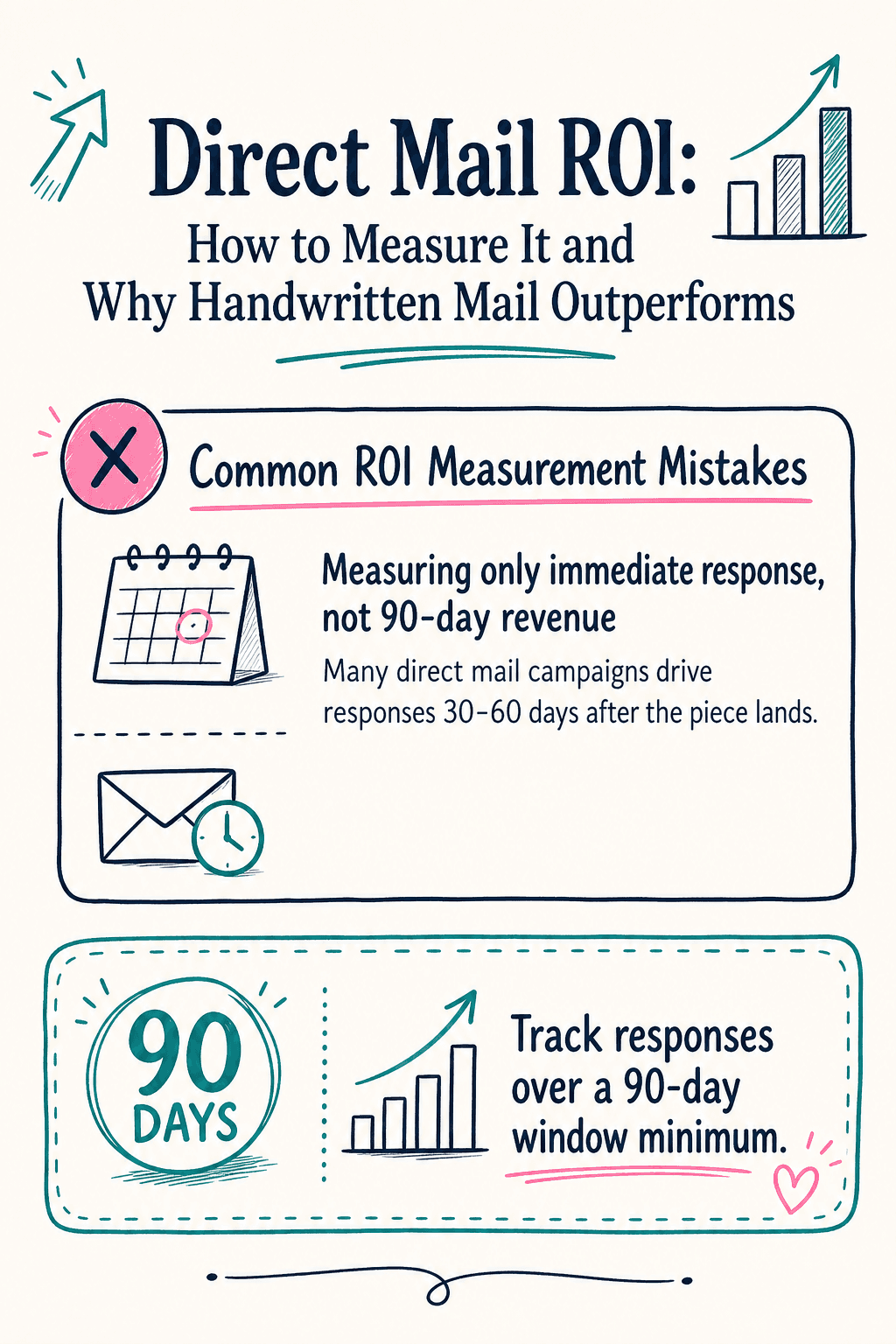
Measuring only immediate response, not 90-day revenue
Many direct mail campaigns drive responses 30-60 days after the piece lands. Cutting off measurement at two weeks underestimates ROI significantly. Track responses over a 90-day window minimum.
Not accounting for multi-touch attribution
A prospect who received a direct mail piece, then clicked a retargeted ad, then converted via search should not have 100% of the revenue attributed to search. Agree a multi-touch attribution model before the campaign runs, not after.
Comparing direct mail cost-per-click to digital
Cost-per-click comparisons are meaningless for direct mail because direct mail doesn't generate clicks -- it generates attention, responses, and conversions. The right comparison metric is cost-per-response or cost-per-acquisition, where direct mail is typically competitive.
Frequently Asked Questions
What is a good ROI for direct mail?
Industry benchmarks put average direct mail ROI at 35% standalone and 112% as part of a multi-channel campaign. For well-targeted campaigns with strong personalisation, 200-400% ROI is achievable. Handwritten direct mail targeting high-value segments consistently delivers at the top end of this range.
How do you calculate direct mail ROI?
ROI = ((Revenue generated - Campaign cost) / Campaign cost) x 100. Campaign cost should include all-in cost per piece multiplied by volume. Revenue should be tracked over a 90-day window using a unique URL, promo code, or matched control group for attribution.
Is direct mail ROI higher than email?
On a cost-per-piece basis, email delivers higher ROI because the cost per send is near zero. On a response rate basis and revenue-per-response basis, direct mail significantly outperforms email. The channels are most effective when used together -- direct mail to high-value or lapsed segments, email for volume.
How long does it take to see ROI from a direct mail campaign?
Most direct mail responses come within 2-6 weeks of the piece landing. Full 90-day tracking captures the majority of responses. For retention campaigns where the goal is LTV impact rather than immediate response, 12-month measurement is more appropriate.
Does handwritten mail really have better ROI than printed direct mail?
Yes, for the right use cases. Handwritten mail has a 99% open rate versus 80-90% for printed direct mail, and response rates of 15-25% versus the 4.4% industry average. For high-value prospect outreach and client retention, the ROI difference is significant. For high-volume, low-value campaigns, printed direct mail at scale makes more economic sense.
The Bottom Line
Direct mail ROI is measurable, it's competitive with digital channels, and it gets better when you add personalisation and handwriting. Those are not controversial claims. They're in the data.
The teams that treat direct mail as an unmeasurable 'brand' channel are leaving returns on the table. Set up the attribution correctly, model the expected return before you send, and measure at 90 days.
Ready to run a campaign? Start with Scribble and track your ROI from day one.