Direct Mail for E-Commerce: How DTC Brands Use Physical Mail to Drive Repeat Purchases
Email alone won't retain your e-commerce customers. Here is how DTC brands are using direct mail and handwritten cards to drive repeat purchases, reduce churn, and increase LTV.
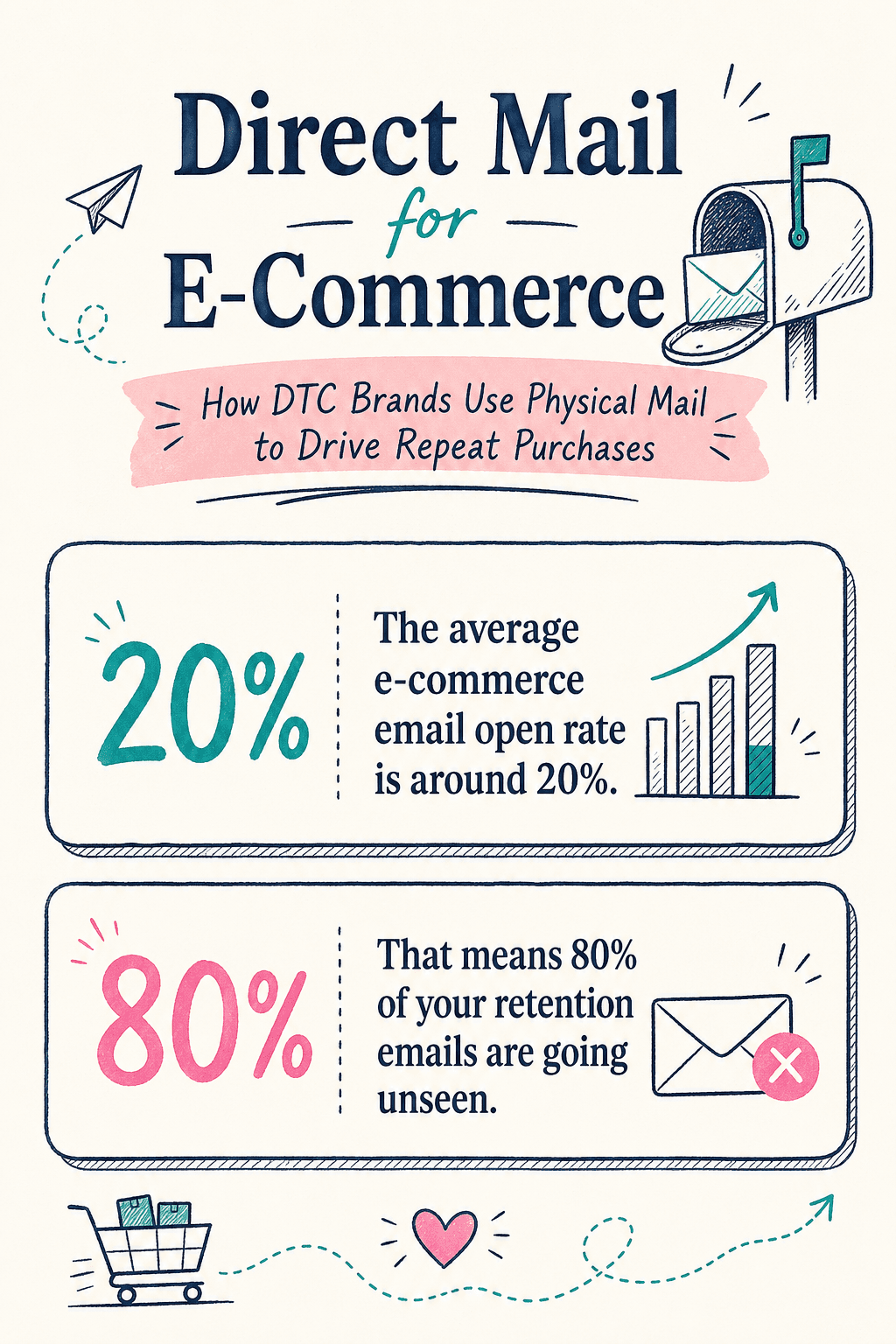
The average e-commerce email open rate is around 20%. That means 80% of your retention emails are going unseen. For DTC brands that live or die on repeat purchase rates, that number should be alarming.
I've watched DTC brands spend heavily on email automation and get diminishing returns year over year. The brands that are winning on retention right now are the ones that added a physical channel. Not instead of email. Alongside it.
Direct mail for e-commerce is not about sending catalogues. The highest-performing use cases are targeted, trigger-based, and personal. This post covers exactly what they are and how to execute them.
Why Direct Mail Works for E-Commerce
Email inboxes are saturated. The average DTC customer is on dozens of brand lists. Physical mail arrives in a different context entirely. 44% of direct mail is kept in homes for reference for a month or more. No email has ever sat on someone's kitchen table for 30 days.
The response rate gap is significant. Direct mail averages a 4.4% response rate compared to email's 0.12%. For win-back and retention campaigns specifically, where re-engaging a lapsed customer is the goal, that differential translates directly to recovered revenue. For more context on how direct mail stacks up, see these direct mail statistics.
There's also a brand perception angle. A physical piece of mail signals investment. It says the brand thinks the customer is worth more than a slot in a drip sequence. That signal matters more for e-commerce brands where the purchase decision is often emotional.
The 5 Highest-Impact Use Cases
1. Post-Purchase Thank You Cards
The first purchase is the hardest to get and the most important to protect. A handwritten thank you card arriving 3-5 days after a first order is one of the highest-ROI retention moves available to an e-commerce brand.
The timing matters. The card arrives when the customer has just received the product, is in a positive emotional state about the brand, and hasn't yet been buried by your automated email sequence. It's the moment when a personal gesture lands hardest.
At Scribble, the brands we see get the best results from these cards keep them short. Three to five sentences. A genuine thank you, a specific reference to what they ordered if possible, and an open invitation to come back. No coupon code, no upsell. Just a card. For a deeper look at why this works, see our guide to handwritten thank you cards.
2. Win-Back Campaigns for Lapsed Customers
Define "lapsed" for your brand. Typically that's 90-180 days since last purchase. Email win-back sequences get low open rates from lapsed customers precisely because those customers have already tuned out your emails. A physical piece of mail interrupts that pattern.
Win-back direct mail works best when it references the previous relationship directly. "We haven't seen you in a while" is a starting point. Better is something that references a specific product category they've bought before or a new arrival in a category they've shown interest in.
Include a time-limited offer, but keep it specific. A 15% discount on a product category they've purchased before outperforms a generic 10% off sitewide. Specificity signals that the offer was created for them, even if it wasn't.
3. High-Value Customer VIP Cards
Not every customer in your database deserves the same investment. The top 10-20% by LTV typically represent 60-80% of revenue. For this segment, a handwritten card is not a nice-to-have. It's a retention strategy with a measurable return.
VIP cards work best as unexpected gestures. A card sent on the anniversary of a customer's first purchase, after a significant spend milestone, or alongside a high-value order has no coupon code attached. The message is the offer. "We appreciate you" lands differently when it arrives handwritten in the mail than when it arrives as a subject line.
I've seen brands using Scribble for exactly this use case. Identifying their top customers by LTV, triggering a handwritten card at the 12-month anniversary, and seeing measurably higher repurchase rates in that cohort versus a control group. The card costs a few dollars. The retained customer is worth hundreds.

4. Cart Abandonment Recovery
Email cart abandonment sequences are table stakes. Most DTC brands have them. The open rates are decent for the first email (around 40-50%) but drop sharply with each follow-up. A physical card arriving 5-7 days after abandonment, for carts above a certain value threshold, adds a channel when email has already run its course.
Cart abandonment direct mail works best for high-consideration purchases. A $30 order doesn't justify the investment. A $200+ cart where the customer was clearly interested but hesitated does.
Keep the message simple. Acknowledge the hesitation without being pushy. A clear CTA to return and complete the order. A customer service contact if they have questions. No hard sell.
5. Post-Review Request Card
Review velocity matters for e-commerce brands. Both for platform algorithms and for conversion rates. A handwritten card asking for a review, sent after a confirmed positive experience, gets a higher response rate than an automated email because it feels like a genuine personal request rather than a system prompt.
Time this card to arrive 10-14 days after delivery, once the customer has had time to use the product. Keep it genuinely personal in tone. "Would you be willing to share what you thought?" is a different ask than "Leave a review and get 10% off."
The brands that execute this well don't incentivize the review. They ask because they care about feedback. That framing comes through in the card.
Building a Direct Mail Flow Alongside Your Email Sequences
Direct mail doesn't replace email. It covers the gaps email misses and applies more investment where the LTV justifies it. Here's how to think about layering the two channels:
Day 0-3 post-purchase: automated email confirmation and shipping update (email)
Day 3-5 post-purchase: handwritten thank you card dispatched (direct mail)
Day 14: product review request email (email)
Day 21: review request card for high-value orders only (direct mail)
Day 90 no repurchase: win-back email sequence begins (email)
Day 105 no repurchase: win-back direct mail if email unopened (direct mail)
The direct mail touchpoints don't need to be frequent to be effective. Two or three well-timed physical pieces in a customer lifecycle can meaningfully lift LTV without requiring the volume that makes catalogues and print campaigns expensive. For more on campaign execution, see these direct mail marketing tips.
Personalisation at Scale for E-Commerce
The main objection to direct mail from e-commerce teams is scale. Writing a personal card for 10 customers is manageable. Writing one for 10,000 is not. This is exactly the problem that platforms like Scribble are built to solve.
With CRM integration, you can trigger handwritten cards automatically based on customer behaviour: first purchase made, LTV threshold crossed, churn risk triggered, review left. The card is physically handwritten by a robot using a real pen. It arrives in a handwritten envelope. The recipient experience is identical to receiving a handwritten card from a human.
For DTC brands that have built a brand on feel and story, this channel extends that brand perception into the physical world in a way that no email template can replicate. Getting the message right is where direct mail personalisation becomes the real differentiator.
What to Measure
Direct mail attribution is straightforward with the right setup. Include a unique URL or QR code per campaign, a unique promo code per send, or a dedicated phone number. Track redemption rate against a matched control group that didn't receive the mail.
The metrics that matter most for e-commerce direct mail are: repurchase rate (did the recipient buy again within 90 days?), average order value on the next purchase, and LTV delta between recipients and control group at 12 months.
In our experience at Scribble, the brands that measure this properly are consistently surprised by the return. The cost per card is low relative to the LTV of the customer you're retaining. The payback period on a well-run handwritten thank you card programme is typically measured in days, not months.
For a full breakdown of how to model and track returns across channels, see our guide to direct mail ROI.
Frequently Asked Questions
Is direct mail worth it for small e-commerce brands?
Yes, especially for high-value or high-margin products. You don't need volume to make direct mail work. A small brand sending 50-100 handwritten thank you cards per month to their best customers can see measurable retention improvement without significant budget. The cost per card is low; the impact on LTV is disproportionate.
How much does direct mail for e-commerce cost?
Handwritten cards via platforms like Scribble range from around $3.50 per card at low volumes down to $1.40 at high volumes, including printing, handwriting, envelope, and postage. For a post-purchase thank you card programme, the cost is typically recovered within the first repurchase the card drives.
How do I integrate direct mail into my e-commerce platform?
Most direct mail platforms, including Scribble, offer CRM and e-commerce integrations that trigger card sends automatically based on events in your order management system. Common integrations include Shopify, Klaviyo, and HubSpot. For smaller volumes, a manual CSV upload workflow is also straightforward.
What is the response rate for e-commerce direct mail?
Direct mail averages a 4.4% response rate overall, compared to 0.12% for email. For trigger-based campaigns targeting specific customer behaviours, response rates are typically higher. Win-back campaigns via direct mail consistently outperform email win-back by 3-5x in head-to-head comparisons.
Should I include a discount in my direct mail?
Depends on the use case. For win-back and cart abandonment, a time-limited offer improves response. For post-purchase thank you cards and VIP recognition, no discount is often better. The card itself is the message. Adding a coupon code changes the tone from genuine appreciation to a marketing promotion.
Ready to Add Direct Mail to Your Retention Stack?
E-commerce brands are competing for attention in a channel that gets more saturated every year. Email is not going away. But the brands that are winning on retention are the ones that added a physical channel to complement it.
The use cases above don't require a large budget or a separate marketing team. They require a clear understanding of which customer moments matter most, and the decision to treat those moments as worth more than an automated email.
Start a campaign with Scribble and see what direct mail adds to your retention numbers.